






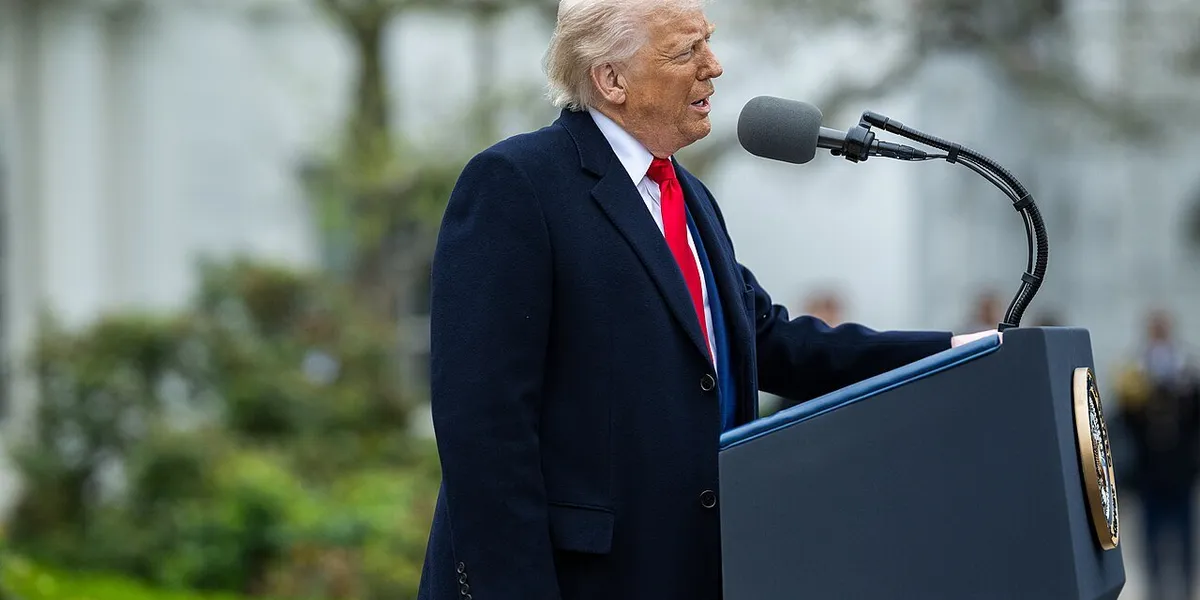
President Donald Trump’s anti-environmental philosophy has led to many controversies, from his rejection of the scientific consensus about man-made climate change to spreading misinformation about wind turbines.
Read more Conservative pundit says Trump only has ‘months left’ to govern
“During its first year, the second Trump administration used a “shock and awe” approach to environmental deregulation,” wrote Slate’s Richard L. Revesz on Sunday. “In an effort to erase climate policies, the Environmental Protection Agency claimed that climate change was not a serious problem, pointing to a report by hand-picked climate skeptics.”
Revesz added, “The criticisms of the National Academy of Sciences and other prominent scientific organizations were so devastating that the EPA abandoned its reliance on the report when it eliminated key greenhouse gas standards, instead basing its decision primarily on shaky legal arguments.”
Slate goes on to explain how Trump has deregulated everything from greenhouse gas emissions to other forms of pollutants, all in the name of creating a more business-friendly environment at the expense of a healthy natural environment.
“The EPA is now routinely determining that the benefits of reducing air pollution—that is, life-saving health benefits for Americans—are too uncertain to quantify or value at all in regulatory decisionmaking,” Revesz wrote. “The administration is doing this without any analysis or citation to scientific studies. Extensive peer-reviewed science has used sophisticated techniques to quantify the impacts of pollution reductions and account for related uncertainty.”
Revesz continued, “And the EPA has relied on these findings for decades, including during the first Trump administration and other Republican administrations. But, beginning this year, EPA administrator Lee Zeldin has decided that every health benefit from air pollution reductions is too uncertain to count—and every regulatory cost dispositive.”
Read more Trump isn’t the disease — he’s just a boil on the American system
The result of this policy is that the EPA will no longer include estimates about how many lives were saved, how many diseases were averted and how many hospitalizations are not going to happen as a result of Trump’s anti-environmental policies. For this reason, Americans cannot learn about the health hazards posed by such measures as repealing a vehicle emissions rule, learning about the consequences of getting rid of air pollution regulations for wood products and eliminating emissions for coal and oil power plants.
“The EPA’s actions are plainly illegal,” Revesz pointed out. “Agencies cannot put a thumb on the scale by taking account of a rule’s costs but not its benefits, particularly when there are established techniques for valuing the benefits.”
He continued, “Because there is no ‘big ticket’ action like last year’s questioning of climate change, the EPA’s approach has largely gone under the radar. Zeldin appears to be following John Oliver’s adage that if you want to do something harmful, “put it inside something boring” to avoid public scrutiny. But the American people will suffer greatly as a result of these illegal actions, in the form of additional premature deaths, asthma attacks, hospitalizations, and other serious health consequences.”
Though not mentioned in the Slate article, one consequence of Trump’s anti-environmental policies is the return of an ecological disaster that previous administrations had gotten rid of — acid rain.
“Last year, [ecologist Gene] Likens told The Guardian that Trump’s current assault on clear air and clean water regulations could pitch the U.S. back into a new era of acid rain,” The New Republic reported in March. “In the 2025 Guardian interview, he called acid rain a ‘major environmental success story’ and warned that if Trump relaxed controls on emissions, ‘we are going to destroy that success story.'”