


Republican voters in Arizona sent a litany of election deniers to the November ballot, chief among them the nominees for the top three statewide offices. But they’re far from the only ones who advanced to the general election.
Read more Trump’s apocalyptic attack plan is doomed to backfire: legal scholars
The Grand Canyon State has long been at the center of the election conspiracy theories that have become a tenet of the modern Republican Party under President Donald Trump, who has been doggedly focused on false claims of election fraud over the past decade.
As the belief that elections are rife with fraud — at least when Democrats win — has transformed from fringe online discourse into a GOP article of faith, adherents and promoters of election conspiracy theories have been gaining more elected power.
But those views are growing more unpopular among voters, as issues such as affordability and the war in Iran take center stage.
GET THE MORNING HEADLINES.
“It is not sustainable, and people do not have an appetite for it. People want to have our elections be a process that helps us pick our leaders and then they want our leaders to lead for us,” Alex Gulotta, All Voting is Local Action’s Arizona state director, told the Arizona Mirror. “It is not winning people’s hearts and minds.”
Despite that, a growing number of election deniers are running for office in Arizona and across the country, according to Kelly Rader, research director at States United Action, a nonpartisan nonprofit that supports state officials protecting elections and has been tracking election deniers since 2022.
Arizona is one of four states — along with Colorado, Wisconsin and Tennessee — that have three or more election deniers running for statewide office, according to their analysis.
Nationally, nearly 75% of the states have an election denier running for a statewide or congressional office, Rader’s research found. That is 139 candidates across the country, among them 21 candidates for governor, nine running for secretary of state and eight running for attorney general, according to the data.
“Election denial is a comprehensive strategy to undermine trust in our elections so that Trump and his allies can challenge election results they don’t like,” Rader said. “As we move through the primaries and sprint toward the fall, we expect that Trump will continue pushing the same old election conspiracy theories. And we are closely watching which election denier candidates echo those claims in the months to come.”
Gulotta echoed those sentiments, adding that Trump’s continued denialism of the results of the 2020 election has helped fuel the fire for candidates to use the same rhetoric.
“I think as long as the president of the United States and his cronies are acting in a way that seeks to prevent voting and is really focused on denying the results of elections, we will continue to see this,” he said. “I am hoping we will grow out of it soon, hopefully another cycle or two.”
Rader said the corrosive effect of lies about election results has far-reaching effects, but was optimistic about the work being done by the nation’s election administrators to educate people and counter the conspiracies.
“Efforts to undermine confidence in legitimate election outcomes don’t just threaten individual races; they erode voter confidence and threaten one of the most important limits on presidential power,” she said. “The good news is that election officials across the country are educating voters, rebuilding trust, and working to ensure another free and fair election this year.”
It isn’t just election denialism that is on the ballot, either.
This year’s batch of conspiracy-minded candidates ranges from QAnon adherents to former “audit” workers. Some of them may be well known to most Arizonans, while others are newcomers to electoral politics.
The old guard
The top of the ticket in Arizona will be a who’s who of people who have been involved in election related conspiracy activities since 2020.
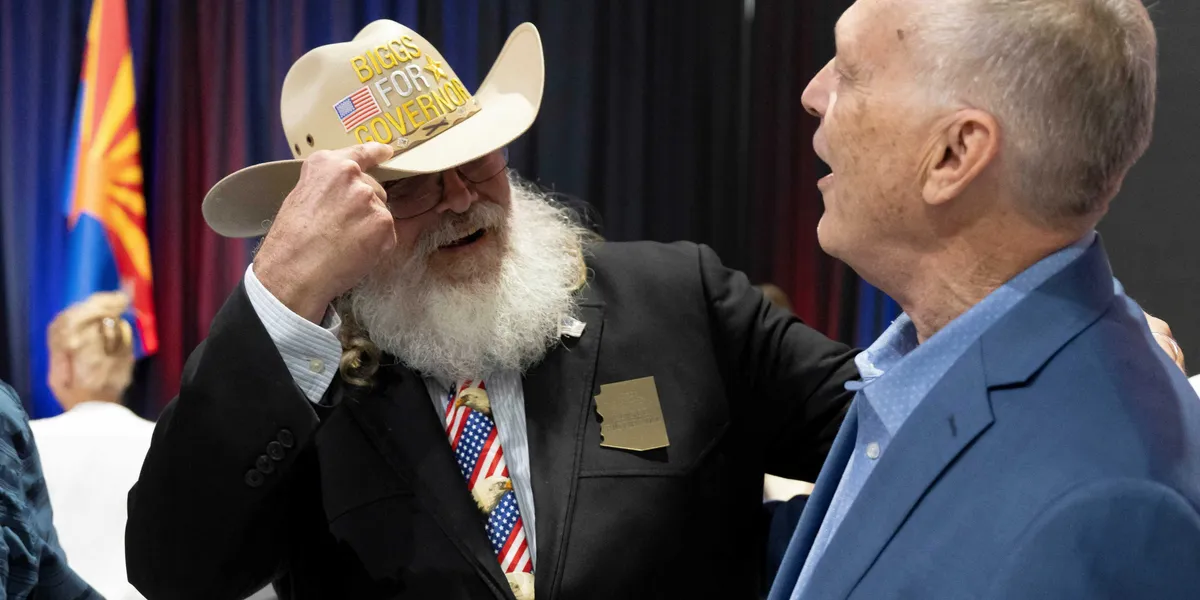
U.S. Rep. Andy Biggs won the Republican party primary for Governor where he will square off against Democratic Gov. Katie Hobbs in November.
After Trump lost his 2020 re-election bid to Joe Biden, Biggs was front and center in Arizona and Congress trying to “Stop the Steal.” He joined fellow Arizona GOP Congressman Paul Gosar in spreading doubt about the results of the 2020 election and made claims of voter disenfranchisement that were not backed up by evidence.
Former Arizona Speaker of the House Rusty Bowers said Biggs called him the morning of January 6 asking him to sign onto a letter calling for the decertification of Arizona electors. Biggs, who voted to reject electoral votes for Biden from Arizona and other battleground states, would later allegedly seek a pardon from Trump for his involvement.
Two other prominent election deniers will also be at the top of the Arizona ticket.
State Rep. Alexander Kolodin, who won the GOP primary for secretary of state, has long pushed unfounded claims around the state’s elections.
Read more Inside the record-breaking grocery nightmare Trump tried to hide from you
Kolodin was one of the key attorneys for Trump’s campaign who challenged the 2020 election results in the state and has represented a number of prominent election deniers. Kolodin was sanctioned by the Arizona State Bar in 2023 for his part in lawsuits challenging the 2020 election that made implausible and evidence-free claims of massive election fraud. He represented Trump’s campaign in the so-called “kraken” lawsuit in Arizona that was based on claims made by people with no actual knowledge of the elections.
In his time in the legislature, Kolodin has pushed for sweeping changes to Arizona election laws largely based on election conspiracy theories.
Then there’s GOP attorney general nominee Warren Petersen, who currently serves as president of the Arizona Senate. He, along with former Senate President Karen Fann, oversaw the partisan “audit” that the Senate conducted in 2021 to scour for fraud in Maricopa County’s election the year before. It found no evidence of fraud, and actually concluded that Biden won the election in the state’s largest county.
Earlier this year, he handed over material from that election review to the FBI and U.S. Department of Justice.
Other prominent election deniers also won their primaries, including Sen. Wendy Rogers, R-Flagstaff. On top of believing the 2020 election was fraudulent, Rogers has also engaged with white nationalists and other extremists.
She’ll also likely be joined in the Senate again by Sen. David Farnsworth, R-Mesa, who has openly embraced QAnon and spread conspiracy theories about the Department of Child Safety.
In its simplest form, QAnon is a conspiracy theory that alleges that a cabal of Satan-worshiping pedophiles are running a global sex-trafficking ring, control world governments and are trying to bring down President Donald Trump — who is himself single-handedly dismantling the cabal.
Farnsworth and Rogers also will be joined by the QAnon-posting and January-6-insurrection-attending Sen. Janae Shamp, who ran uncontested in her primary.
Another prominent election denier who won their primary is former Pinal County Sheriff Mark Lamb.
Lamb worked with other far-right sheriffs and a group that was involved with the widely debunked film “2000 Mules” to police polling locations in 2022. Lamb won his primary despite lurid allegations about his sex life and the release of a racist chat he had with a border vigilante.
If he wins his election — which is likely, as his district is deep red — he’ll join fellow election denier U.S. Rep. Abe Hamadeh, who unsuccessfully tried to claim election fraud led to his 280-vote loss to Kris Mayes in the 2022 contest for attorney general.
The new class
Among the well-known pushers of conspiracy theories in the state are some new faces that are seeking political power.
For instance, Michelle Altherr is seeking to unseat Democratic Sen. Brian Fernandez in the Democrat-leaning Legislative District 23.
Altherr worked at the partisan election “audit,” citing it as one of the main reasons she has gotten into politics. She has long been a presence at Maricopa County Board of Supervisors meetings, where she has spread unfounded claims of election fraud.
Another new face is James Rogers, who won his primary for the state House of Representatives in Legislative District 10. Rogers has represented Maricopa County Recorder Justin Heap, a known election denier, as part of the America First Legal law firm, which was started by top Trump advisor Stephen Miller.
The law firm was also behind a failed lawsuit that attempted to change how Arizona counties use drop boxes and maintain voter rolls.
Then there’s Mylie Biggs, Andy Biggs’ daughter, who won an uncontested race to represent Legislative District 14 in the state Senate.
Last year, during an appearance on The Matt MacCurdy program, she said that she doesn’t believe women should hold public office. On that same podcast, the younger Biggs said she has a fondness for conspiracy theories, telling the host to not get her “started on 9/11.”
Early voting for the general election starts on Sept. 19 for military and overseas voters and early voting for everyone else begins on Oct. 7. The last day voters can register to vote and apply for an early ballot is Oct. 5. Voters can find more information and register to vote at this link.
Read more Most Utahns wanted to protect their history — but Trump had other plans