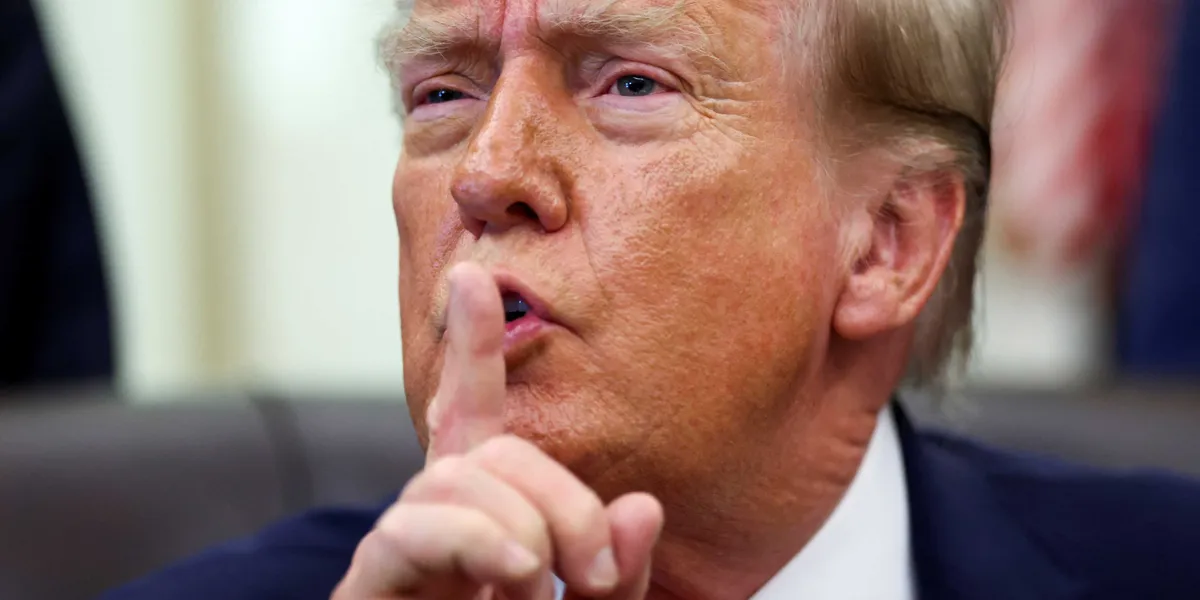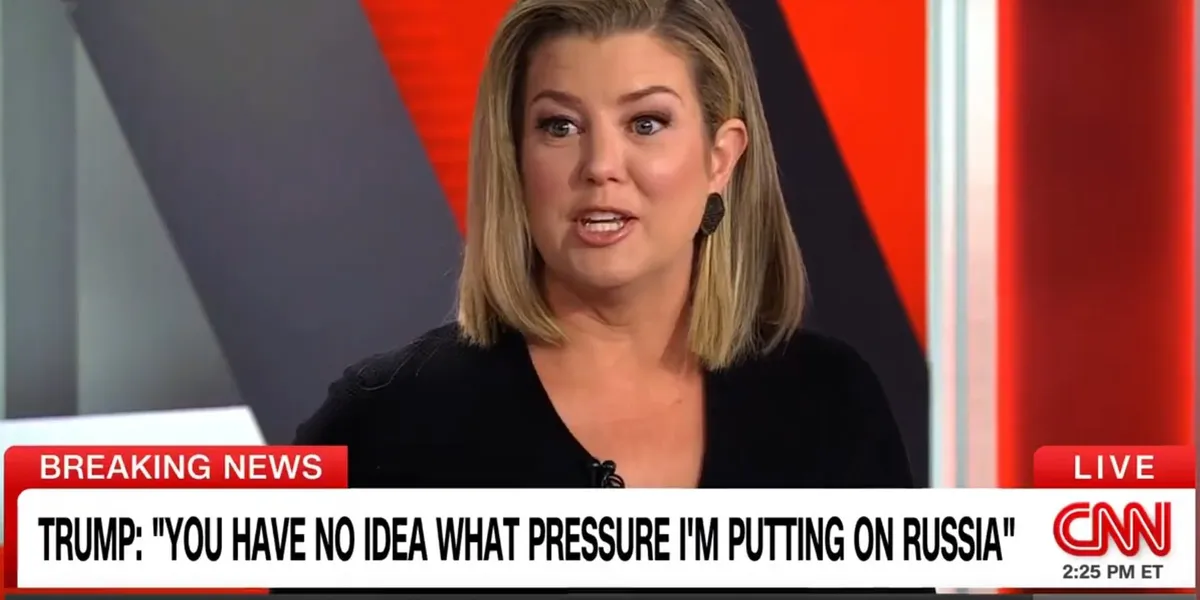







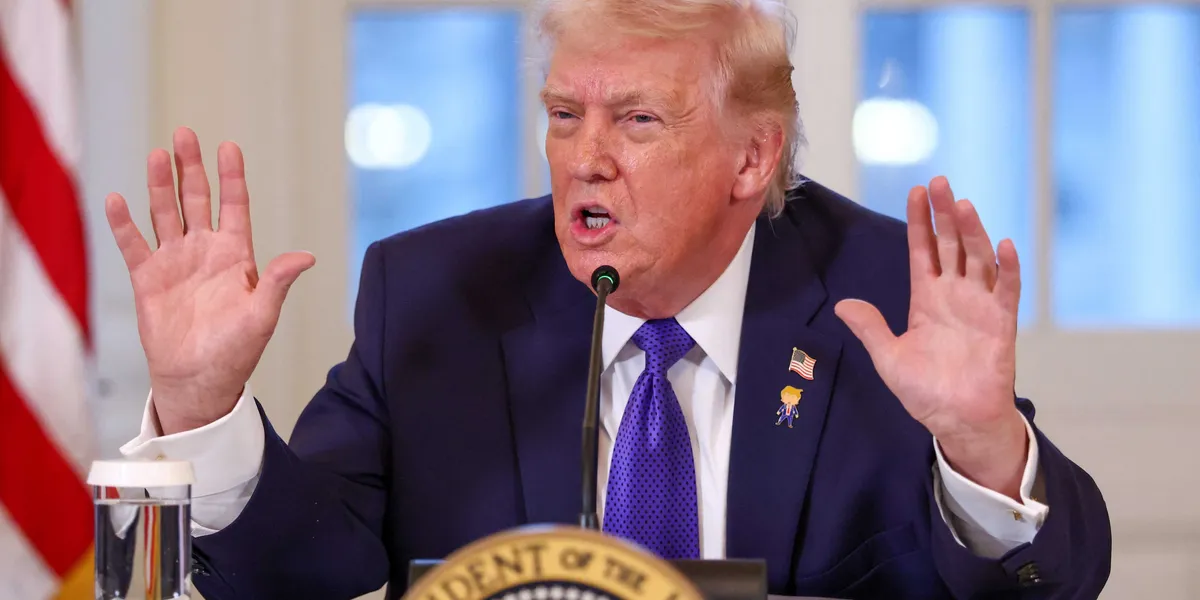
President Donald Trump has already made it clear he plans on rigging the 2026 midterm elections. From trying to implement a multitude of voter suppression measures (like purging voter roles, demanding voter ID, sending troops to the polls, seizing ballot boxes and interfering with mail-in voting) to refusing to give a whit about public opinion, Trump is obviously worried that if the American people have a say, they will put Democrats in control of one or both chambers of Congress.
Read more Body language expert exposes Trump’s signs of ‘anger and embarrassment’ on live TV
Yet he is not merely doing this to maintain his own personal hold on power. Trump is a man with a plan — the same plan, not coincidentally, that America’s rich and powerful have worked on for more than a century. To better understand this agenda, AlterNet had an in-depth interview with historian Thom Hartmann, whose new book Who Killed the American Dream?: The Greatest Political Crime Ever Told addresses these very topics. While he has plenty of rough words for Trump, Who Killed the American Dream? is far more than just another anti-MAGA book. In great detail, Hartmann lays out how the fascist plutocracy that Trump is trying to make into a literal dictatorship has its roots all the way back in the 19th century.
This interview has been lightly edited for clarity and context.
MATTHEW ROZSA: First, your book focuses on Santa Clara County v. Southern Pacific Railroad Company, and argues that from this case all the way through Citizens United v. Federal Election Commission, there has been an anti-democratic pattern of the Supreme Court acting like corporations have the same rights as people. Can you elaborate, in layperson’s terms, why this jurisprudential assumption has been so toxic?
THOM HARTMANN: Sure.
For the first, basically, 100 years of the Republic, everybody understood that there were two kinds of persons: natural persons and artificial persons. Natural persons are you and me, human beings — we have protections in the Constitution, and we even have rights specified in the Constitution through the Bill of Rights and the 14th Amendment. Artificial persons were corporations and nonprofits and churches and other kinds of entities that were not human, but had to have some sort of personhood status in order to pay taxes, sign contracts, sue or be sued, open checking accounts, things like that. And that distinction was always quite clear. In 1886, the railroads tried to argue that they were being unfairly taxed between two different counties in California because the tax rates were different, and that this was not equal protection under the law, which is what the 14th Amendment says all persons are entitled to.
The court did not rule in their favor, at least with regard to that argument in that case. But the clerk of the court and one of the Supreme Court justices conspired to assert that it had. And that assertion, which was in the headnote of the 1886 decision, kind of lay around like a hand grenade until it was picked up by Lewis Powell in 1978 with the Bellotti v. Baird decision, and then really set off with the Reagan Revolution — John Roberts, the Reagan Justice Department, and then the Supreme Court. I think Citizens United in 2010 is probably the most classic example of it. Now, to more directly answer your question: the reason a corporation can pour money into a politician or a political campaign to get a politician elected who will do their bidding is because the Supreme Court has since ruled that corporations have rights under the First Amendment, and those rights include the right to free speech.
But because a corporation doesn’t have a mouth, they did this workaround, saying, “Well, its money is the same thing as its mouth, so it can speak with its money.” There’s another example, under the Fourth Amendment. The Fourth Amendment says the government cannot invade your privacy unless somebody swears before a judge that there’s reason to believe you committed a crime. Well, Dow Chemical was illegally venting benzene into the air over one of their chemical factories, and the EPA found out about it and flew an airplane over the factory to photograph it and use it as evidence to stop them. Dow Chemical sued and took it all the way to the Supreme Court, and the court ruled that under the Fourth Amendment, Dow Chemical has privacy rights. So now it’s almost impossible for the federal government, or state governments for that matter, to do surprise inspections of factories and polluting facilities, et cetera.
Corporations have also claimed rights under the Fifth Amendment, which says you cannot be forced to testify against yourself and that the government can’t take your assets without due process of law — that they don’t have to admit to crimes in court, they don’t have to testify in ways that could hurt them, and that the government can’t take their property if they commit crimes. These are just a few of the more obvious examples, but this whole idea that a corporation should have rights under the Bill of Rights, which was specifically designed for human beings, is nuts. The way this got into law was through Stephen J. Field, the corrupt Supreme Court justice who had been promised he would be sponsored to run for president by one of the big railroads of the day, and John Chandler Bancroft Davis, the clerk of the court, whose father was the governor of Massachusetts and who was himself a very wealthy man and a former railroad CEO. The two of them got together and wrote this into the headnote of the 1886 case, which completely contradicted the actual decision.
Headnotes have no legal standing — they’re just a summary of the case for law students and people doing research. But it was in the headnote. And here’s the thing: the Supreme Court justice quoted in the headnote was dead by the time it was published. His name was Morrison Waite. He was suffering from congestive heart failure in 1886, and he was dead the next year, or maybe the year after — but the decision wasn’t published for several years, that’s how long it took them to write it up and get it typeset. So he never even knew. What happened was the railroad hired a guy by the name of [Rep. and later Sen.] Roscoe Conkling [of New York], who was a member of the—
ROZSA: I’m familiar with him. He had a turkey-gobbler strut [a famous insult against him by his Republican arch-rival, Sen. James G. Blaine of Maine].
HARTMANN: Exactly. And there was a senator whose name is escaping me, and the two of them had been on the committee that wrote the 14th Amendment. They did a tour around the country that lasted several years, for which the railroads paid them big bucks, claiming before various legislatures and legal groups that they had intentionally written the 14th Amendment to say that all persons — rather than all natural persons — are entitled to equal protection under the law, because they had intended the amendment to include corporations. Now, that’s just a flat-out lie, but they were quite effective with this PR campaign through the early 1890s, to the point where, in the late 1890s, the Supreme Court actually cited the headnote in a decision, and that was when it arguably became law. Like I said, it was used a few times in relatively small ways over the following decades, and it really got picked up in ’78 with the Bellotti decision, and then got turned into a massive weapon to destroy our democracy — not just our economy — in 2010 with Citizens United.
ROZSA: I appreciate you being so thorough. I’d like to dive into my own area of specialty. I wrote my master’s thesis on President Grover Cleveland’s 1887 State of the Union message, which focused on tariff reform. I also wrote a last year about how Democrats tend to do better when they are low tariff. I’m particularly intrigued by President Cleveland’s 1894 letter, in which he referred to high tariffs as, quote, a “communism of pelf.” And I kept thinking of that phrase while reading your book, because, as I see it, what Trump is doing with his protectionist tariffs is not only creating a communism of pelf, but doing so in large part because the Supreme Court has made that kind of chicanery legal. I’m curious how you feel about that argument. Pelf is an archaic or derogatory term for money, riches, or wealth.
HARTMANN: Okay. Yeah — in his State of the Union address in 1887, he talked about how we now see trusts and combinations that have arisen. I’m paraphrasing terribly here, but from memory, that have arisen and threaten to crush the average person — you know, corporations, which should be the carefully constrained servants of the people, have become their masters, and the average person is thus under the iron heel of these corporations. I mean, Cleveland knew what was going on. [laughs] There’s no doubt about that. So we could debate or discuss the value, or non-value, of tariffs or other protectionist policies — which Alexander Hamilton was a big fan of, in his Report on Manufactures, in 1798.
Or 1780 — I forget what year it was, I think it was 1798. But certainly the empire of pelf, or the conspiracy of communism of pelf.
ROZSA: Communism of pelf
HARTMANN: Yeah, there you go. Well, in that time, communism had a quite different meaning than it does now. There’s a fascinating book of Lincoln’s correspondence with Karl Marx. Marxism and communism were being widely discussed during that era. So communism was, essentially, sharing the wealth — it wasn’t viewed as a dictatorial political system the way it has been since the inception of the Soviet Union. So I’m not sure if that’s what you’re looking for in terms of opinion or thoughts, but—
ROZSA: Okay, I appreciate you being so thorough. My next question is about the “deflection scam” you describe, in which, since President Ronald Reagan — or, as historian Rick Perlstein might say, going as far back as President Richard Nixon — Republicans have deflected from issues of economic inequality and plutocracy by blaming African Americans, immigrants, gay people, trans people —
HARTMANN: —women —
ROZSA: the poor themselves. And you discuss how this rhetoric has permeated every area of American political life, so that even neoliberal Democrats frequently offer a sort of Diet Coke version of the same demagoguery. My question for you is: when people are talking to conservatives and/or Trump supporters on a day-to-day, casual basis, what can they do to puncture these deflection strategies and instead get people to focus on the issues that actually matter?
HARTMANN: That’s a great question. It’s the subject of my op-ed today at hartmannreport.com, which will probably get picked up by Raw Story or AlterNet tomorrow. Number one — when they try using hate, which is really the scaffolding for those distraction techniques, you call it out. You just say, using hate like that is beneath you, it’s un-American. I’m disappointed in you, I’m surprised you’d even go there. The other thing to point out is that from 1981 until today — that’s 45 years — there has not been one single major piece of legislation proposed by Republicans, passed by a majority of Republicans in the House and Senate, and signed into law by a Republican president, whose principal beneficiary was the average working person. Not one.
I’ve been doing a radio program for 23 years, and I’ve run a contest for all 23 years saying I’ll give an autographed copy of a book to anybody who can name even one. There have been a couple of small things, like George Herbert Walker Bush’s “no call” list [laughs], which turned out to be a scam by and large. But there isn’t one. So you would simply point out to them that every major social advance — and not just the social advances, literally the things that made the middle class possible — was advanced by the Democratic Party since 1933. In ’33, when FDR was elected president, maybe 20 percent — it depends on whose definitions you’re using, but roughly 20 percent — of the American population was in the middle class, and that was pretty good for an industrialized country.
Read more Biographer says Melania legal battle exposes ‘Trump law in a nutshell’
No country had ever surpassed 50 percent. FDR put into place Social Security, the right to unionize, the minimum wage, workplace protections, vigorously enforced anti-monopoly laws, a 90 percent top individual income tax rate, a 50 percent top corporate income tax rate — a whole series of programs that benefited average people and created that infrastructure, that scaffold, on which the middle class could rise. By 1981, when Reagan was elected, two-thirds of us — 65, 66 percent — were in the middle class, with a single paycheck. And I’m using Teddy Roosevelt’s definition of the middle class, which is: enough to buy a house, enough to buy a car, enough to put your kids through school, enough to have savings for retirement, enough to take a vacation every year.
That was his Square Deal, if you go back and look it up. Now it’s only 41 to 45 percent of us who are in the middle class, and now it takes two paychecks. So what happened? Well, 45 years of Reaganomics, according to the RAND Corporation, have transferred $70 trillion out of the wealth, pockets, homes, and everything else of the middle class and working class, and into the money bins of the top 1 percent. We’ve seen an explosion of wealth inequality that has never been seen before, even in the industrialized world, in the modern era. I mean, it’s pharaonic — it’s like ancient Egypt. And now you’ve got guys who are richer than any pharaoh ever imagined in his wildest dreams. So that’s the consequence — that’s why they have to constantly—
That’s why, with every election, the Republicans have to identify a villain, because they can’t talk about what they’ve accomplished. The only thing they’ve accomplished is reducing taxes on billionaires and big corporations, and in the process running up a national debt of $35 trillion — which is roughly the same amount as the sum total impact of the Reagan, Bush, and Trump tax cuts. So what do they do? They say, “Hey, look over there — that Black person,” or “here comes a migrant caravan,” or “look at these brown people, they’re rapists and murderers,” or “those women want your job in the workplace, they must be feminazis.” It just goes on and on. In 2024, it was, “those trans people are coming for your kids — do you want to pay for their surgeries?”
There’s always a villain. It’s purely to shift the conversation away from how Republican policies have gutted the American middle class, and in the process, largely damaged our democracy.
ROZSA: I appreciate you being so thorough. My next question is about the multi-plank platform you propose to revitalize democracy. It includes — and I’m listing them off — one, rebuilding unions; two, taxing oligarchs; three, making healthcare affordable; four, making education accessible; five, making housing affordable; six, antitrust enforcement; seven, living wages; and eight, addressing climate change. My question for you is: do you believe the mainstream Democratic Party and/or the Democratic socialist wing of the party have effective strategies and policy approaches to achieve those results?
HARTMANN: I certainly think it’s possible. With the exception of climate change, we’ve already done every single one of those things in the past, and they all worked out quite well — and then they were deconstructed by Republicans. My mother graduated from Michigan State University and paid her own way — she was poor, and worked as a lifeguard during the summer up in Charlevoix, Michigan. My dad went to college on the GI Bill. He came from a poor family — not dirt poor, but his parents were Norwegian immigrants, and his father was a woodworker. My dad got a job at a tool and die shop, and out of that single paycheck he bought a house, and a new car every three years.
He had four sons — I’m the oldest of four boys — and he put us all through school. He retired, and he’s traveled the world with his pension and his Social Security. We’ve done it before, so it shouldn’t be that difficult to do again. And I think it would even tap into that nostalgia that MAGA lives on — “Make America Great Again,” Ronald Reagan’s famous phrase that Donald Trump appropriated. It seems like it should be possible. The question, or the problem, is that about half of the elected members of the Democratic Party right now are themselves legally on the take, because of these Supreme Court decisions that this book is all about — on the take from the very corporations that benefit from not doing those things.
And that really started in the early ’90s, when Bill Clinton was confronted with the reality that Reagan had taken us — historically, the Democratic Party had been funded by the unions, and Reagan took us from about a third of all American workers being unionized to under 10 percent in less than 12 years. So when Clinton ran for president, the unions couldn’t support him in a way that would’ve gotten him elected. So he said, “Okay, we’re going to have to get in bed with the corporations — let’s at least find good corporations, so we’ll get in bed with the banks and the insurance companies, because at least they don’t poison the air and pollute the water.” That has not worked out so well. It got him elected, and it was necessary at the time.
Then Obama proved that you could actually do fundraising using the internet, and that’s allowed the rise of the Sanders wing of the party — the progressive wing, the AOC wing — which relies on individual donations instead. But in the meantime, the Supreme Court massively tilted the playing field with Citizens United, again based on this 1886 lie. So it’s going to be a hell of a challenge. You’ve got a number of Democrats who are just nakedly on the take and frequently voting against their own party — a little over a dozen of them just this week did that again, and we know who they are. [laughs] Some of them seem quite proud of it. So the party’s got some work to do.
The country’s got some work to do too. But at the end of the day, I’m an optimist. I think Americans are figuring out what’s going on — I think the jig is up. Trump’s excesses and abuses have been so extreme, and the GOP’s support of them has been so lacking in virtue, shall we say, so nakedly self-interested, that Americans are disgusted by it. They want honest government, and they want their middle class back.
ROZSA: I suppose my question is, do you believe that all of these efforts Trump is making to crush protests and seize voting machines will be effective, or will the Democrats be able to counter them? I know that Senate Minority Leader Schumer apparently convened a caucus of Democrats earlier today to discuss strategies for countering this. Do you think it will work, or do you think Trump will prevail?
HARTMANN: Well, I don’t know much about what Schumer was planning — probably another strongly worded letter. But what I do know is that after the 2024 election, a friend of mine, Greg Palast, a former BBC and Guardian reporter who broke the story in 2000 about how Jeb Bush purged 90,000 Black people off the rolls just weeks before the 2000 election so his brother could win Florida and become president — Greg Palast, who has a master’s degree in statistics in addition to his journalism background, and was a student of Milton Friedman’s at the University of Chicago, went to the official government statistics, state by state and federal, on who was allowed to vote and who was purged from the voting rolls leading up to and during the 2024 election. What he found was that about four million people who were legally qualified citizen voters were not allowed to vote.
About half of them had been purged in these massive voter purges — Georgia was kind of the epicenter of this; Greg made a movie about it called Vigilantes, Inc. The other half were affected by a variety of techniques: Republican poll workers challenging mail-in ballot signatures, people being given provisional ballots instead of real ballots. With a provisional ballot, in most states you have to show up in person at the Secretary of State’s office within a week or two in order for your ballot to be counted — it’s called being cured. There’s a whole bunch of other things too — cutting the hours the polling places were open, moving them around without notice, phoning in bomb threats. You can’t say that was the Republican Party, but that happened a lot in 2024 in very critical swing districts for Democrats.
He was able to demonstrate — and he’s published this — that had those four million people been able to vote (and we now know who those four million people were), Kamala Harris would have been president, and Democrats would control the House and Senate. So it has already worked for them. And this time, they realize it’s going to take more than purging four million people — they’re going to have to do six, eight, ten million people. The question is, will the Democrats be able to turn out enough people, and will Republican voters be sufficiently disheartened by the failures of the Trump administration that an overwhelming blue wave crashes upon our shores? If it turns out to be a tight election, the voter suppression efforts will probably succeed. So we’ve got a big job ahead of us.
ROZSA: All right, and my final question, which is about your book: to what extent is Trump a revolution, and to what extent is he merely an evolution of what began with Nixon, Reagan, and the Bushes?
HARTMANN: There’s a word that’s escaping me at the moment — going back to an old system — that works in the context of evolution, revolution… it’s not devolution. I would argue that he’s a reactionary, basically. He’s trying to reinvent the Confederacy. In fact, he’s literally trying to reinvent the Confederacy, in as much as he’s bringing back the Confederate statues, the Confederate names, and rewriting history to celebrate the Confederacy. And of course, the Confederacy was very hostile to voting, to democracy — it had utterly lost democracy by the 1850s. And then they rose up and declared war against the remaining democracy, which was the northern half of America, in an effort to eliminate democracy in the United States altogether and establish a coast-to-coast oligarchy.
I would argue that that’s Trump’s mission right now — to recreate that. So whatever word you want to use to describe it, that’s what it is.
Read more Republicans fuming in ‘frustration’ as McConnell’s health remains a mystery