






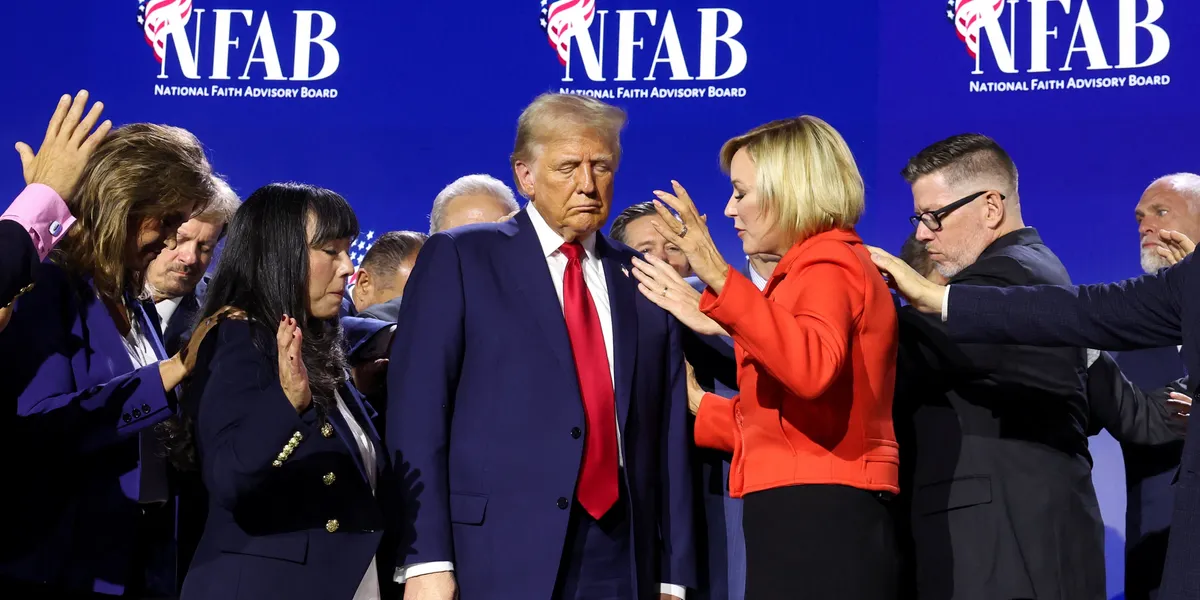
Even as Christian nationalist views decline throughout the United States, one pastor closely linked to President Donald Trump and Secretary of Defense Pete Hegseth is gaining more power through his influence at the Pentagon.
Read more Trump’s presidency is crumbling due to the same MAGA players that empowered him
“Pastor Doug Wilson gave a surprisingly dispassionate interview to NPR’s Leila Fadel last week,” wrote The Dispatch’s Michael Reneau and Hannah Anderson for The Dispatch on Sunday. “I describe it as ‘surprisingly dispassionate’ because in the interview, Wilson espoused repealing the 19th Amendment, ending no-fault divorce, and introducing religious tests for public office; yet his delivery of these radical ideas was decidedly unbothered—a marked contrast to the responses the interview elicited from evangelicals and beyond. The emotional gap between Wilson’s rhetoric and how people respond to it is one of the defining features of his public presence. It’s also a key to understanding his ideas and how he uses them.”
Wilson is an evangelical pastor from Moscow, Idaho, who is particularly influential with Hegseth and the Defense Secretary’s inner circle. Wilson was even invited to preach at a Pentagon worship service that the cabinet officer began last year.
“Given his proximity to power, Wilson has become the subject of national media coverage, which often focuses on his claim to want to establish the United States as a Christian theocracy,” The Dispatch wrote. “Such language conjures visions of a real-life Gilead, the authoritarian and patriarchal republic that is the setting for The Handmaid’s Tale, but it would be a mistake to read Wilson as an ideologue. In fact, he spoke pragmatically in the NPR interview, naming the work of democracy as the work of persuasion. Wilson’s demeanor, even if slightly awkward, was not forceful or aggressive. He was measured, friendly, playful. But that disconnect—between the weight of what Wilson is suggesting and how easily he suggests it—is what’s concerning. “
The Dispatch pundits identify Wilson as a dangerous theocrat precisely because he is able to present his ideas in a seemingly rational manner, and also knows how to pull them back when he arouses controversy. In that vein, he also knows how to make his critics seem like they are being uncivil when they object to what he says and does.
“One way Wilson distinguishes himself, however, is how he uses radical ideas,” The Dispatch explained. “Unlike those who might hide a radical agenda, Wilson speaks openly about it—almost performatively. Those familiar with his broader body of work know that he delights in the drama of it all in much the same way that President Donald Trump seems to. Wilson doesn’t reverse course so much as place responsibility for the drama on others. He courts outrage and then retreats to the abstract when others react. ‘Screamers,’ he called them in the NPR interview.”
They added, “Speaking with Fadel, Wilson suggested that previous interviewers just threw ‘mud at the wall. You’re a fascist. You’re a Nazi. You’re a thing, you know…’ but now, he’s ‘risen to the dignity of needing to be intelligently opposed.’ In other words, the problem isn’t what he said; it’s that you (mis)understood. You were too sensitive. Satire is a legitimate form of argumentation, and you don’t understand how rhetoric works.”
Even when Wilson treads on incendiary ground, like downplaying the horrors of American slavery or encouraging people to interact with child sex abusers, he does not seem to lose influence within the MAGA universe.
Read more Trump’s new nominees rip the mask off the same fatal flaw
“Wilson’s ability to separate the theoretical and actual also explains how he could devote his first book to a philosophical exploration of American slavery, writing that it was a ‘normal sinful situation’ rather than an ‘apocalyptic evil,’” The Dispatch explained. “The cover image is of a ‘black and tan,’ a mixed drink made by pouring a darker beer over a lighter one. This same indifference explains how Wilson could guide a young woman who was a New St. Andrew’s student to marry a convicted pedophile who was a part of their church community (and who had abused children within the church as an NSA student himself). Not only did Wilson mishandle the previous cases of sexual abuse, he diagnosed the groom’s behavior as ‘temptation,’ with the theoretical cure being sexual expression in marriage. The groom was later removed from the home when a judge ruled he could not live with his infant son due to failed polygraphs and further violations.”
They concluded, “If being a pastor is akin to being a doctor, Wilson is the doctor willing to experiment on his patients. And now, it seems, the nation itself.”
Wilson’s rising influence speaks to how the Trump political structure is inextricably tied to Christian nationalism. In March, The New Yorker’s Rachel Monroe reported that “people not attuned to the evangelical world may have missed the growing prominence of hyper-politicized churches such as Mercy Culture, which have become a key wing of the MAGA coalition. Compared with the religious right of previous generations, this cohort of pastors, influencers, and self-described prophets offers up a version of worship that’s at once more mystical, with an emphasis on supernatural powers, and more militaristic, with heightened political rhetoric.”
Monroe continued, “Many adopt a Christian-nationalist framework, arguing that the United States was founded as a Christian nation and should be governed as such.”
This philosophy directly contradicts the ideas of America’s key founding fathers, including President Thomas Jefferson, who was the chief author of the Declaration of Independence.
“His ’empire of liberty’ offered the potential to dismantle the artificial hierarchies inherited from the past and imbue all aspects of life with the promise of freedom and happiness,” Dean Caivano, an assistant professor of political theory at Lehigh University and author of “A Politics of All: Thomas Jefferson and Radical Democracy,” explained to this author for Salon Magazine in 2024. “Although this idealized image of a free and harmonious American society is undeniably marred by the institution and legacy of slavery, overlooking the role of education and science as prerequisites for freedom and equality diminishes our ability to assess the historical and contemporary limits of American democracy critically.”
Read more Trump’s pardon-for-cash scheme crumbles as wealthy clients spill the beans