
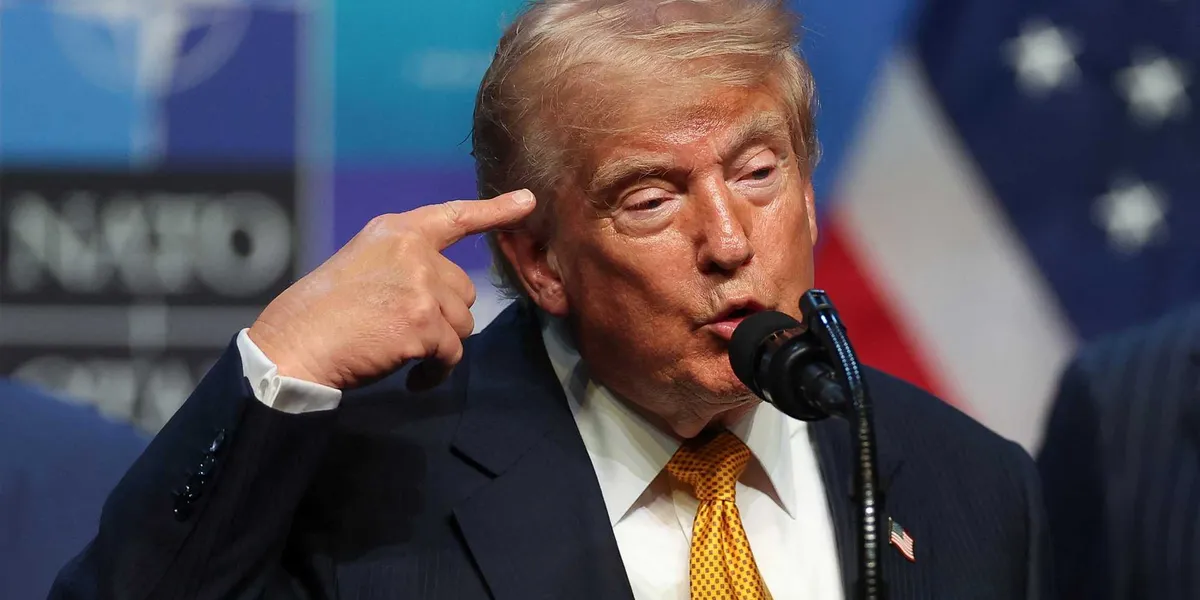
President Donald Trump’s war with Iran has roared back to life, and according to one leading risk analyst, his return to one of his prior strategies is “doomed to fail.”
Read more Trump’s reaction to Lindsey Graham accidentally exposed his own dementia fears
Brett Erickson is a managing principal for Obsidian Risk Advisors, as well as an advisory board member for Seton Hall School of Diplomacy and International Relations and DePaul University Driehaus College of Business. On Wednesday, he published a new op-ed for The Hill about Trump’s pending plan to reimplement a naval blockade of Iran’s ports on the Persian Gulf, a strategy previously utilized in the earlier phase of the war before the doomed “memorandum of understanding.”
While Erickson allowed that “the use of economic warfare can be valid” in some cases where “it can rationally be argued that short-term pain for long-term gain is a valid strategy, particularly as it relates to freeing civilians from a repressive regime,” he argued that without a firm goal in mind, it will only cause “increased suffering for these same people.” This, he wrote, is what appears doomed to happen with Trump’s new blockade of Iran.
“With a renewed blockade of Iran looming on the horizon, it is becoming increasingly fantastical to argue that another round of economic warfare would accomplish anything beyond inflicting even greater suffering on the Iranian people we claim to want to help,” Erickson wrote. “The tools of economic warfare are justifiable only if there is a realistic expectation that they can produce the strategic outcomes they are employed to achieve. There must be a favorable risk-reward proposition. A pipe dream is not a valid strategy when the downside risk is a severe humanitarian crisis.”
Read more Right-wingers cheer as Fox’s Tomi Lahren tears into Trump’s Republican party
He continued: “With President Trump announcing a renewed blockade of Iran, and with the previous memorandum of understanding in tatters, everything now points towards even more aggressive economic warfare campaign than we saw the first time around — think of it as Operation Economic Fury 2.0. But a critical question still needs to be answered by those advocating it: Why would we possibly expect this to succeed now?”
Erickson noted that it is entirely within the realm of possibility that another blockade could eventually produce enough economic pressure to make Iran surrender. However, such an outcome currently appears far from likely, and the “mere possibility is not enough to justify the downside risks.” He argued that the “burden of proof” for reimposing a blockade should be “dramatically higher” than the first time around, and said that backers of the idea must provide meaningful evidence that it will go better this time.
“The proponents of a renewed pressure campaign need to prove that there is a high enough probability of success to justify causing an even deeper humanitarian crisis against an Iran that is now better positioned than ever to withstand it,” he concluded. “Frankly, there is no reason to believe it does. The new blockade of Iran would not erase the failure of the first campaign. It would repeat it under even less favorable conditions, at an even greater humanitarian cost, directly harming the very people Washington claims it wants to help.”
Read more ‘Gasps’ in Senate hearing after Todd Blanche slips in stunning reveal