

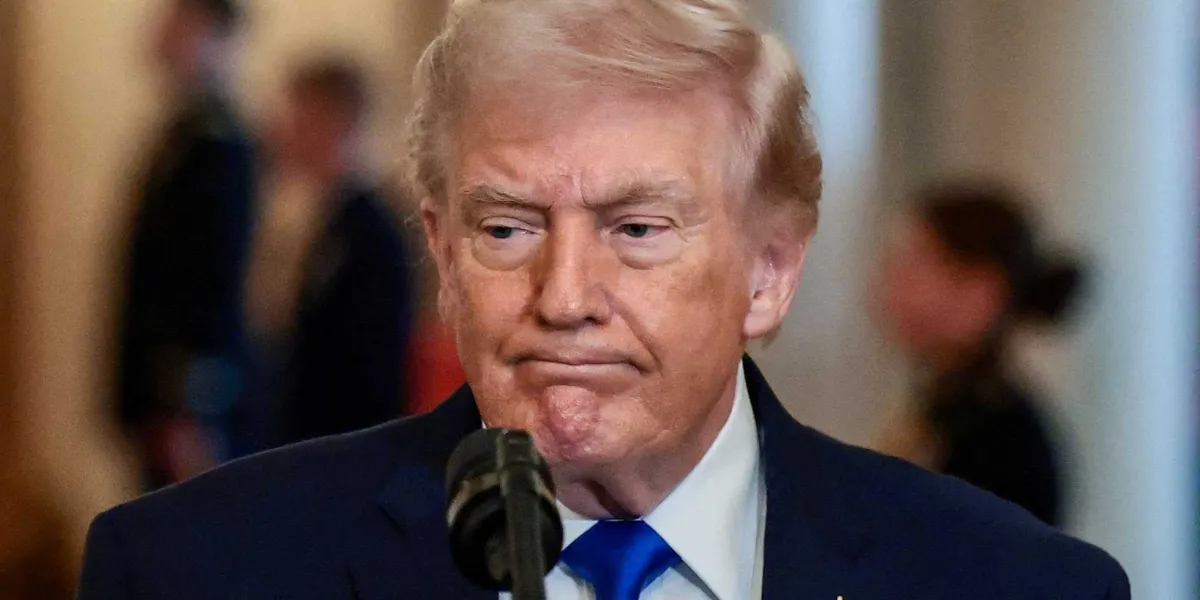
On Tuesday, a federal judge issued a ruling on President Donald Trump’s controversial IRS “slush fund” settlement that attorney and legal analyst Jay Kuo calls a “masterclass in legal analysis and logic.” As a result, Trump’s effort to reward his loyalists has been seriously hindered.
Read more Republican corners attorney general hopeful over claim Trump IRS fund is ‘moot’
According to Kuo, “U.S. District Judge Kathleen M. Williams, an Obama appointee sitting in Miami, handed down a in Trump v. Internal Revenue Service, voiding the ‘settlement’ between President Trump and his own Justice Department and referring two of his lawyers for possible discipline. The fact pattern she tackled — a sitting president suing an agency he controls, then ‘settling’ with himself to secure a windfall benefiting his political allies — was straight out of a law professor’s box of exam tricks. But it was no match for Judge Williams. She not only dismantled the government’s claims, but also identified new novel concerns.”
Kuo says that it was clear where the decision was headed when the judge wrote in its first pages that she declined to accept “the credulous exercise of divorcing President Trump’s current job title from an understanding of what happened here.” In other words, she was making clear the “conflict of interest” that arose from the president overseeing settlements with himself.
Furthermore, the legal precedent had already been set that courts “do not engage in the academic pastime of rendering judgments in favor of persons against themselves.” In other words, Trump can’t be on “both sides of his own case,” which was precisely what Judge Williams found, concluding that the “Lead Plaintiff and the Government are one, a fully realized unitary interest,” and that it was “risible” to suggest “that there was ever adverseness between the Parties.” So essentially, notes Kuo, the judge was agreeing with Trump’s own assessment offered months ago when he declared, “I’m suing myself.” It turns out that’s illegal.
What’s more, Trump’s attorneys had already argued successfully to the Supreme Court that no one in the Executive Branch can be legally “adverse” to the Chief Executive. But now they were arguing the opposite: that the IRS and Treasury were “independent adversaries” of Trump. The judge noted this contradiction.
At this point, says Kuo, the case was essentially over, but the judge went on to support her opinion with a number of other factors. For example, Attorney General Todd Blanche had ordered that the IRS be barred from auditing Trump, but federal statute expressly makes it a crime “for any ‘applicable person,’ including the president and specified White House officials, to ‘request, directly or indirectly’ that the IRS start or stop an audit of a specific taxpayer. Williams wrote that the audit-immunity provision ‘directly contravenes’ the statute.”
Read more Trump’s forever war has entered a ‘scary’ new phase: Nobel economist
She also raised questions as to whether Trump was following constitutional requirements that he “faithfully execute” the laws rather than suspend them for his own benefit. Then there was the constitutional question of “emoluments” beyond the president’s fixed salary, and the judge suggested Trump’s settlement may qualify as illegal compensation.
Beyond that she cited a number of ethics codes, but according to Kuo, the whole opinion can be boiled down to five “uncontroverted facts: 1. Donald Trump is President. 2. President Trump controls the actions of the Secretary of the Treasury Department, the IRS Commissioner and all Executive Branch actors. 3. President Trump, through Executive Order 14215, also controls the litigation strategy and interpretation of the laws guiding the Department of Justice. 4. For the 109 days that this case was pending, no attorney representing the United States filed a notice of appearance or any document indicating the government’s position, interest or awareness of the matter. 5. Defendants’ actions are consonant with the dictates of Executive Order 14215.”
“Because there was never a proper case before the Court,” she therefore concluded, “there was nothing to settle.”
She ended her opinion by quoting John Adams, noting, “facts are stubborn things.” Whatever the parties wished, whatever they’d already agreed among themselves before ever walking into a courtroom, she wrote, they “cannot alter the state of the facts or evade the rule of law.”
Read more Trump spiraling because everyone knows his threats are ‘not to be taken seriously’