






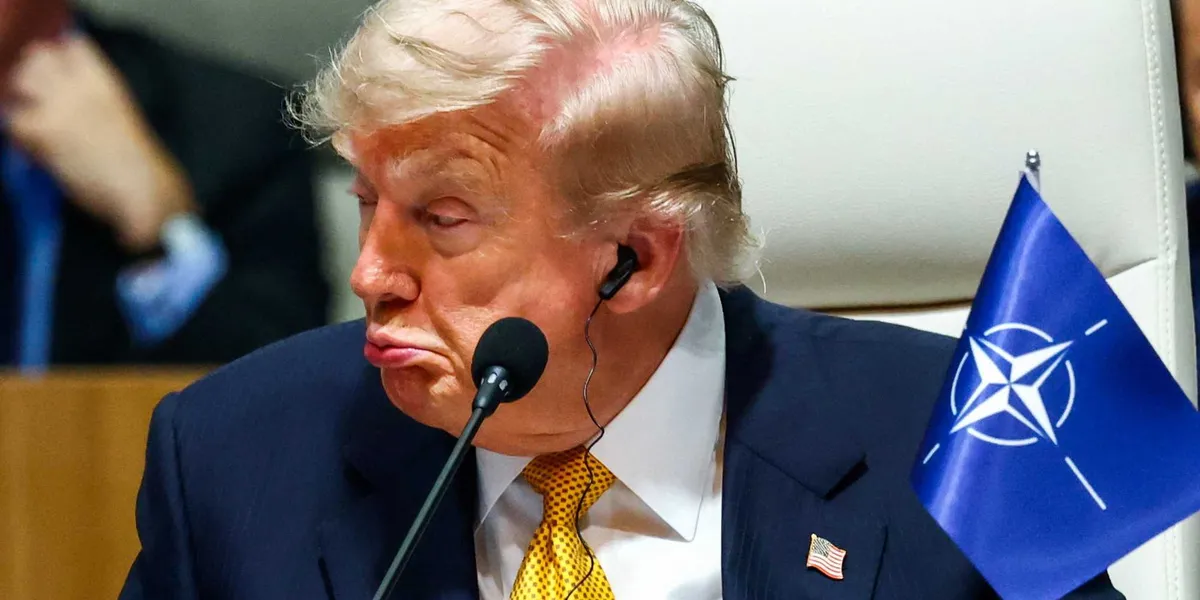
During his visit to Ankara, Turkey for the 2026 NATO Summit, U.S. President Donald Trump declared that the United States’ ceasefire agreement with Iran was “over.” The Iran war, after four and one-half months, continues. And according to analysis from retired U.S. Army Lt. Gen. Mark Hertling in The Bulwark, Trump is — despite the United States’ military might — missing some key points about the conflict.
Read more Trump’s ‘massive gamble’ is doomed to backfire: analysis
“The United States can destroy more targets than Iran,” Herling writes in the conservative Bulwark. “It can sink ships, eliminate missile batteries, strike command centers, and impose military losses that Tehran cannot reciprocate. But Iran does not have to match American firepower to achieve its goals. It must only keep commercial shipping at risk, energy markets unsettled, Gulf governments nervous, American bases under threat, and U.S. forces responding to the next crisis. Washington may be winning most exchanges of fire, but Tehran has the initiative: It still decides, for the most part, where the conflict occurs, which American assets must be defended, and how many additional missions U.S. forces must assume…. With the resumption of combat in the Strait of Hormuz, the United States is being pulled into multiple overlapping campaigns: striking Iranian nuclear and military capabilities, protecting commercial shipping, suppressing coastal missile systems, defending regional bases, and reassuring Gulf partners.”
Hertling, who served as commander of U.S. Army Europe during Barack Obama’s presidency, continues, “But there is no clearly articulated political end state. This is mission creep.”
Hertling emphasizes that while Trump is “unquestionably punishing Iran,” he is “not compelling it to change its behavior.”
Read more Trump biographer alleges Trump cleaned ‘incriminating documents’ from Graham’s house
“Strategy should start with a desired political outcome and then direct military, diplomatic, and economic power toward achieving it,” Hertling writes. “It should not be assembled one retaliatory strike at a time. America’s Gulf partners understand the danger…. The United States can destroy more, but Iran can disrupt more. Iran can lose every tactical encounter and still produce strategic effects. It can raise shipping costs, disrupt energy markets, strain American alliances, expose regional bases, and draw the United States deeper into an open-ended campaign…. Wars are not decided solely by who destroys more. They are decided when military operations break an opponent’s ability, or will, to resist.”
Hertling adds, “Russia and the United States — in very different ways and with greatly varying degrees of professionalism and efficacy — have shown their abilities to destroy.”
Hertling adds, “While Ukraine fights for democracy and freedom and Iran fights against it, both have shown their wills to resist and to win by not losing.”
Read more Billionaire’s investment interview morphs into bizarre Trump praise parade