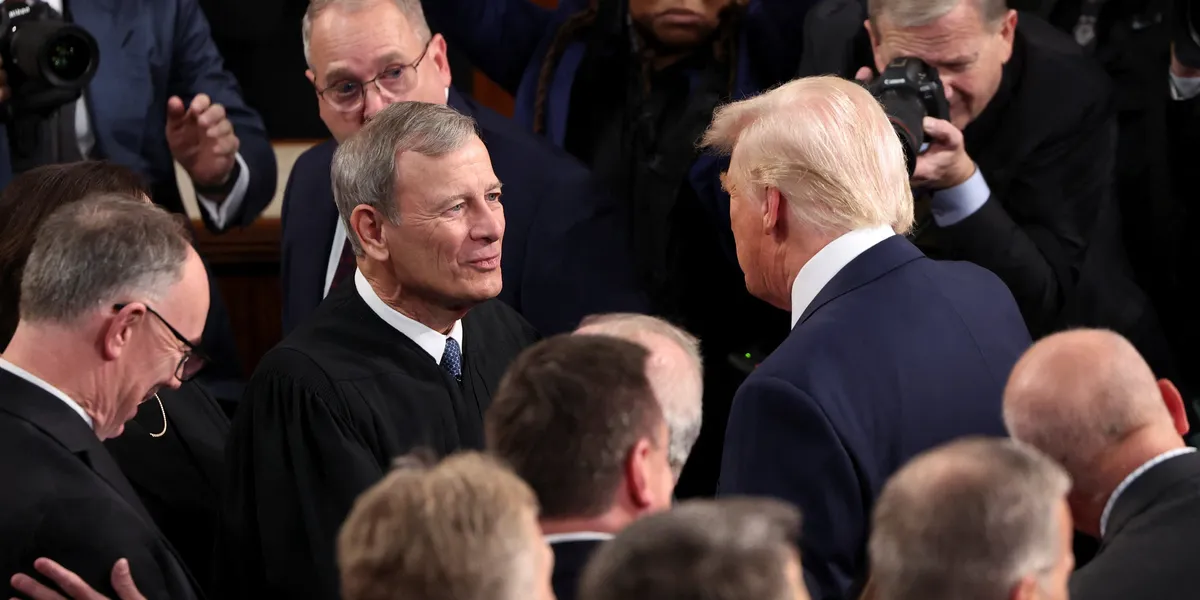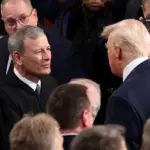






If there’s one problem with the U.S. Supreme Court, it’s that Chief Justice John Roberts has helped accelerate a bigger constitutional project.
Read more Experts sound the alarm on ‘deranged’ Trump for doctored US-Canada-Greenland map
Adam Serwer, justice and politics reporter for The Atlantic, penned a column on Tuesday that described Roberts as the cartoon monkeys who cover their eyes, ears, and mouths, boasting, “see no evil, hear no evil, and speak no evil.” The Roberts court has spent the past several years stripping away the protections promised by the Reconstruction amendments while giving President Donald Trump and the right-wing legal movement room to keep pushing for more.
It isn’t merely that the high court keeps ruling for the right, Serwer explained. It’s that the Court is increasingly willing to look at authoritarian-style power grabs and treat them as anything other than what they are.
Case after case has allowed the conservative majority to expand presidential power while narrowing the reach of anti-discrimination laws.
Serwer said that it began in the first Trump term and has gone into turbo-drive since Trump began his second term, particularly when it comes to immigrants and ethnic minorities.
“The Court’s approach echoes one of the most notorious decisions in American history: the 1944 ruling in Korematsu v. United States, which upheld the forced relocation of tens of thousands of Japanese Americans in the middle of World War II,” he wrote. “With apologies to Fred Korematsu, a brave and honorable man who resisted internment, we could call the Roberts Court’s ‘See no evil’ approach to overt bigotry the Neo-Korematsu Doctrine.”
“Writing on behalf of the majority in Korematsu, Justice Hugo Black—a former Klansman—rebuked his colleagues for suggesting that racism or bigotry was behind the internment of Japanese Americans,” added Serwer, quoting the ruling.
Read more Trump’s idea to honor Lindsey Graham crashes and burns in Congress
“To cast this case into outlines of racial prejudice, without reference to the real military dangers which were presented, merely confuses the issue,” Black wrote. “Pressing public necessity may sometimes justify the existence of such restrictions; racial antagonism never can.”
It wasn’t that long ago that Roberts repudiated Korematsu, saying that it was as “gravely wrong the day it was decided” and “overruled in the court of history.” He said that it “has no place in law under the Constitution.” Oddly, those words appear in the case in which Roberts upheld Trump’s executive order banning people from traveling to the U.S. from predominantly Muslim countries.
It shows Roberts’ willingness to bend doctrine when it suits the project of executive branch authority. So, the presidency, and Trump along with it, keeps scoring more room to do what it wants, while pretending it is just being faithful to history and constitutional structure.
At the same time, the judges are hedging by making their own exceptions while waving away the hardest legal questions using language that amounts to “because we said so.”
Anything culture-war-related has been one-sided, explained Serwer. The justices upheld bans on transgender girls and women in school sports, which has only deepened the pattern of using trans people as a political punching bag. It has become the authority hardening discrimination into U.S. law, while pretending to be measured and moderate.
Ultimately, Serwer closed by saying that the court isn’t just failing to stop the authoritarian drift of the American government. It is quietly smoothing out the path for it.
Read more Trump will try ‘self-pardon’ but he can still be held accountable: ex-federal prosecutor