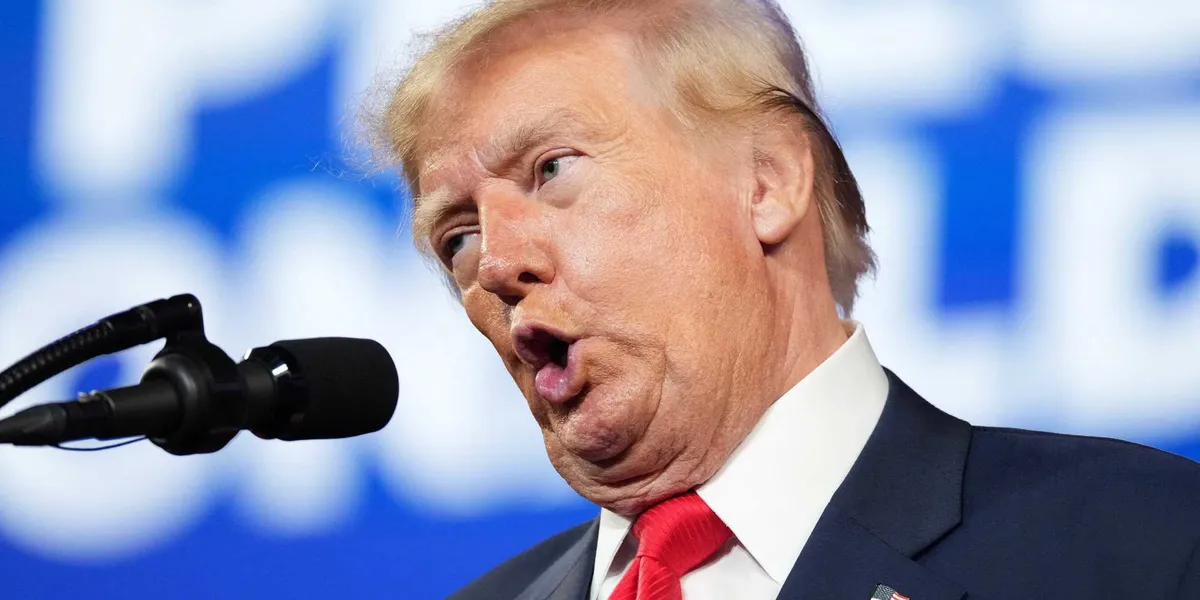





Federal Court Judge Lewis A. Kaplan issued an order that President Donald Trump’s money be given to E. Jean Carroll after the U.S. Supreme Court refused to get involved in the case.
Read more Republicans panic-spend as midterms threaten to wreck their ‘red wall’
There were two Carroll cases, and the high court refused to hear the second one. The court docket shows that Judge Kaplan ordered the disbursement of deposited funds. After the jury ruled against Trump, he handed cash over to the court to be held upon appeal. Trump had to hand over $5 million to Carroll and pay for her attorneys’ fees.
On Wednesday, the judge ordered that both be paid out — with interest.
“The Clerk is further respectfully directed to disburse from [Court Registry Investment System] CRIS the value of the post- judgment interest, computed pursuant to 28 U.S.C. 1961, that has accrued as of the date of this order, to the [Interest on Lawyers’ Trust Accounts] IOLTA account of Kaplan Martin LLP on behalf of Plaintiff E. Jean Carroll, using the disbursing information that has been transmitted to the Clerk Court by counsel for Plaintiff.”
This case is the one with the smaller judgment involving Trump’s defamation of Carroll, saying that she was lying about her sexual assault allegations against him. Trump lost both cases, but the first case was predicated on the decision by the jury, whether or not Trump was guilty of sexual abuse. The jury agreed he was, and as such, he was liable for defaming Carroll.
Trump claimed he made his comments in 2019, while he was president. Trump’s lawyers attempted a kind of legal Hail Mary at the U.S. Supreme Court, saying that because he was president at the time, he can’t be charged. The high court refused to hear it, leaving him stuck.
Read more US Army rushes to remove anti-Trump insults after hackers hijack military websites
The first Carroll case is a much larger judgment, totaling $83.3 million. The interest there has been adding up as well.
The Supreme Court hasn’t weighed in on that one, though the arguments are similar. There, Trump argues presidential immunity should have prevented the jury from being shown certain defamatory statements made publicly because he was president. It isn’t likely to be an effective argument as the statements were made publicly.
Trump also gave a deposition under oath, which was also a key part of the case. There, Trump claimed he couldn’t have assaulted Carroll because she was “not my type” and alleged that it was a “con job.” When under oath for the deposition, however, Trump misidentified Carroll, saying that she looked like his wife at the time, Marla Maples.
“It’s Marla, yeah. That’s my wife,” Trump said, only to be corrected by his lawyer.
Read more Trump’s war on expertise has left US national security in the hands of amateurs