




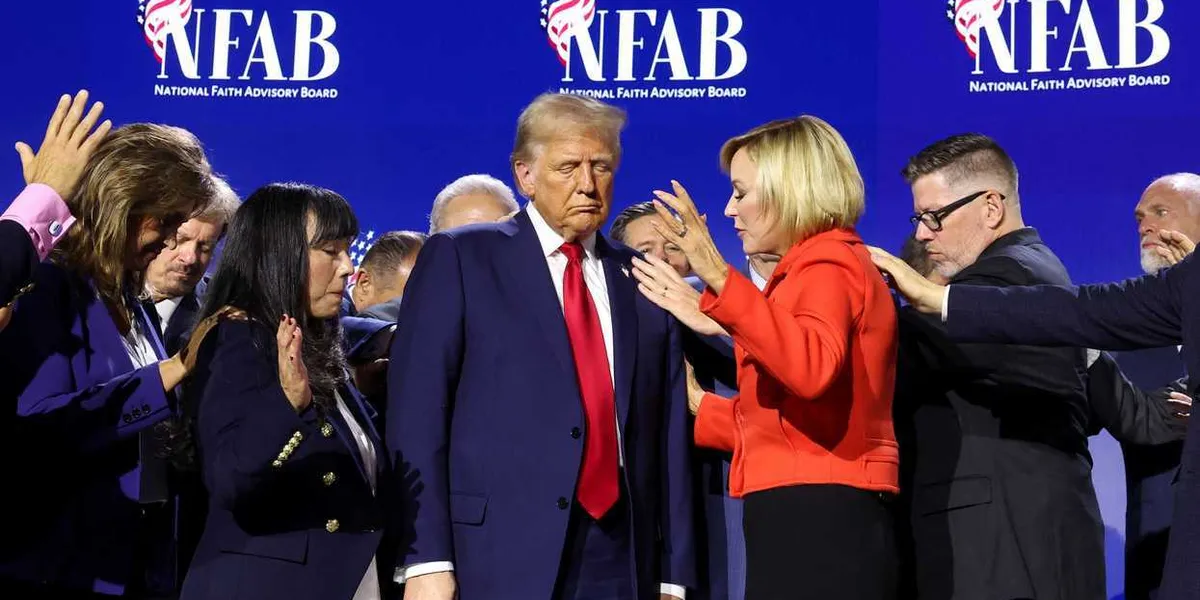
For centuries, Christianity has been having ideological battles, with fundamentalists expressing very different views from the more moderate Protestants and Catholics. In 2026, these heated debates among Christians continue, and an article for the conservative website The Bulwark examines the intense conflict between far-right Christian nationalists and those with a more inclusive view of Christianity.
Read more Conservative economist tells WSJ: Trump is destroying the economy
According to Philip D. Bunn (a political science professor at Covenant College in Lookout Mountain, Georgia), Eli McGowan (a conservative Presbyterian), and Presbyterian professor Emily McGowan, “Christian nationalism” has “ballooned” in the MAGA movement.
“There’s an irony here: Mainstream media accusations of the menace of Christian nationalism encouraged the hard right to own the moniker for themselves,” Bunn, Eli McGowan and Emily McGowan explain in The Bulwark. “Advocates of the term range from evangelicals to Orthodox Christians, who never seem able to agree on an exact definition, leaving alarmed pundits struggling to hit a perpetually moving target. Gen-Z shock influencers like Nick Fuentes, a Catholic, have called themselves Christian nationalists as well. Hop online and ask ten people what Christian nationalism means, you’ll get eleven answers — and maybe a death threat or two.”
The writers note that Christian nationalism “has become a clickbait gold rush.”
“The movement, heavily online but simultaneously entrenched in small groups and churches, has developed its own media ecosystem of influencers, podcasts, films, merchandise,” Bunn, Eli McGowan and Emily McGowan observe. “It also has its own style of performative aesthetics. Beards, demonstrating patriarchal authority and hiding poor ‘physiognomy,’ are omnipresent. Christian nationalism has sometimes overlapped — in terms of adherents and imagery — with other rapidly evolving movements and subcultures, such as ‘tradwives,’ ‘redpilled’ online spaces, and the ‘Manosphere.’ For example, it’s not unusual in Christian nationalist circles to encounter the slang term ‘soy’ as a pejorative for unmanliness, extrapolating from a semi-serious belief that soy-based foods are a testosterone-lowering marker of coastal liberalism. You can even compete in Christian nationalist athletic events.”
Read more Trump’s out of ammunition — and nobody’s buying his new ‘scary’ excuse
But the writers stress that many Catholics and Mainline Protestants vehemently reject Christian nationalism. Presbyterian scholar Matthew D. Taylor, for example, was part of a study that included a passionate “defense of the values of liberal democracy.”
“Blake Callens, a writer and early public critic of Christian nationalism, has noted that ‘one can consider authoritarian Christian nationalism to be fringe enough that it will never gain traction within the broader American system while being keenly aware that it is a growing movement within the conservative church,'” according to Bunn, Eli McGowan and Emily McGowan. “As Christians, we find that Callens’ warning speaks to us directly…. We feel a pressing duty to speak out about this malignant ideology.”
Read more Trump was betrayed by world leaders he never should have trusted: analysis