



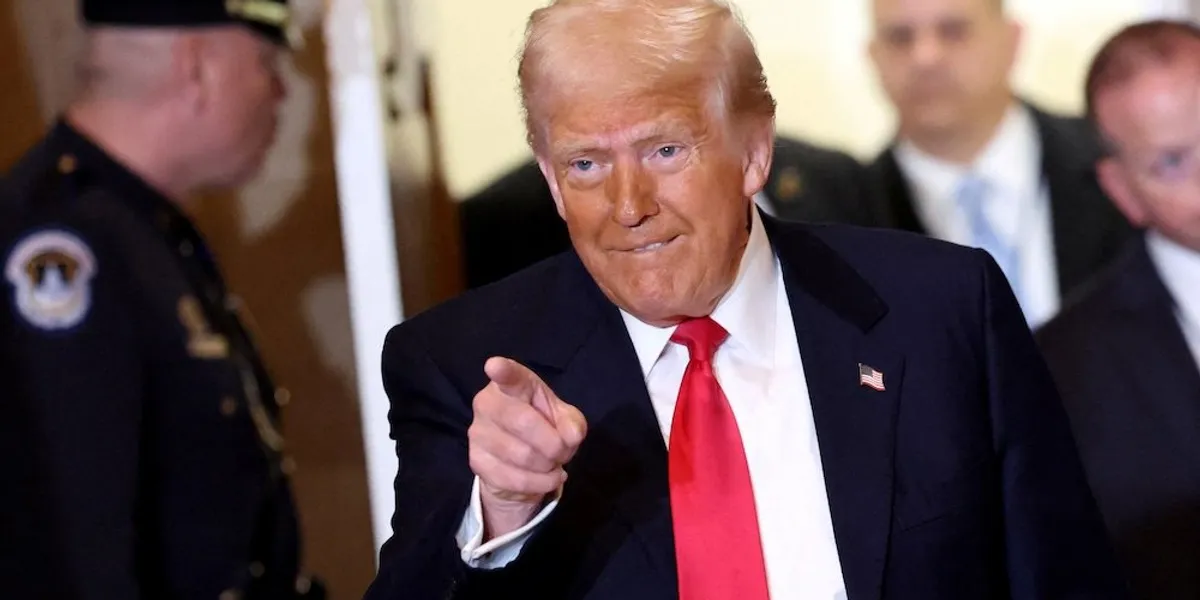
President Donald Trump has recently started blaming Big Oil rather than his war against Iran for rising oil prices — and the editorial page of The Washington Post, owned by billionaire Jeff Bezos, is having none of it.
Read more Lawmaker vows retribution to Trump for ‘stealing’ soldiers’ resources
“Prices are set by supply and demand,” wrote The Washington Post’s Editorial Board on Wednesday. “That economic law is as fundamental as they come, but not for the first time, President Donald Trump is acting like he’s above the law.”
They added, “Trump ripped into energy giants Chevron and ExxonMobil this week for windfall profits amid the Iran war: Chevron reported a quarterly record of $12.1 billion, and ExxonMobil’s $14.5 billion nearly doubled last year’s second quarter profit.”
Referring to Trump’s comment that oil companies are “making too much money based on a shortage” and that “they ought to give some of that back to the public, and they better cut the retail price,” the Post noted that Trump’s invasion of Iran prompted that country to mostly shut down the Strait of Hormuz, which is in fact the primary factor behind rising oil prices.
“The Strait of Hormuz, which accounts for 20 percent of the world’s oil trade, remains largely shut down, driving up the global price,” the Post wrote. “The president might have considered this obvious consequence before he attacked Iran in February and failed to quickly establish American control over the strait.”
The Post continued, “Prices at the pump being roughly $1 higher today per gallon than they were a year ago is the result of decisions made in Washington, not by the oil majors.”
After adding that Trump’s tariffs have also contributed to rising prices, the Post concluded that Trump should direct whatever blame he assigns for the problem back at himself.
“A vital lesson from the war in Iran is that America needs an abundant supply of every form of energy the market can produce,” the Post wrote. “Gas prices would be much higher right now, for example, if progressives had managed to ban fracking a few years ago.”
They concluded, “If the president really wants to bring down prices, he should focus on expanding the supply of oil at home and abroad.”
Read more Trump hammered for wild claim that ‘Melania’ was No 1 movie this year
Ironically, Trump implicitly admitted earlier on Wednesday that his war is in fact the main cause of rising gas prices.
“When oil goes down, and it’s going to go down very rapidly and is already happening, we may have to send it up again, we may have to — you know what happens when we send it up,” Trump told an audience at a Las Vegas rally. “But we don’t have to. But when that oil and gasoline go down, everything else follows. But we have done a great job at reducing prices and we have done an unbelievable job in making our country really, really respected and successful again.”
Speaking to AlterNet in June, Dr. Robert Shapiro — a top economic adviser to President Bill Clinton — confirmed that Trump’s war against Iran has caused oil prices to rise. He added that it is unlikely the problem will be solved even if the war ends quickly.
“Even if hostilities do not restart, the price of oil will not return to pre-Trump levels because there’s a new risk premium that they could restart at any time, increasing tanker insurance costs for example, and because oil infrastructure has been degraded, reducing supply for some time,” Shapiro explained to AlterNet. “An Iran-controlled toll to use the Strait will produce big bucks for Iran, but its impact on world prices for oil, natural gas, helium, etc. should be minimal. Another source of economic friction will be the now-intense uncertainty about what the Trump administration will do next—in the Mideast and in scores of policies at home; and uncertainty dampens investment.”
He concluded, “As it is, the economy was weakening before this crisis began, and these and other factors will exacerbate those downward pressures. A resolution over the next two weeks will not stop the deterioration in economic conditions.”
White House spokeswoman Taylor Rogers replied to these criticisms at the time by telling AlterNet that “the United States’ energy dominance status, as the world’s leading producer and a top exporter of oil and natural gas, has positioned us to not rely on the free flow of oil through the Strait of Hormuz like other countries. If anything, Operation Epic Fury actually underscored the importance of producing reliable, affordable, and secure energy here at home. Many of our allies that have tried transitioning to intermittent and unreliable renewable energy sources have predictably failed to break their reliance on foreign oil that goes through the Strait.”
She added, “Several countries from around the world are now looking to emulate the President’s energy dominance agenda and are advancing new partnerships that enhance their energy security with the United States.”
Read more Trump’s DOJ begs judge for extension after bumbling another court deadline