


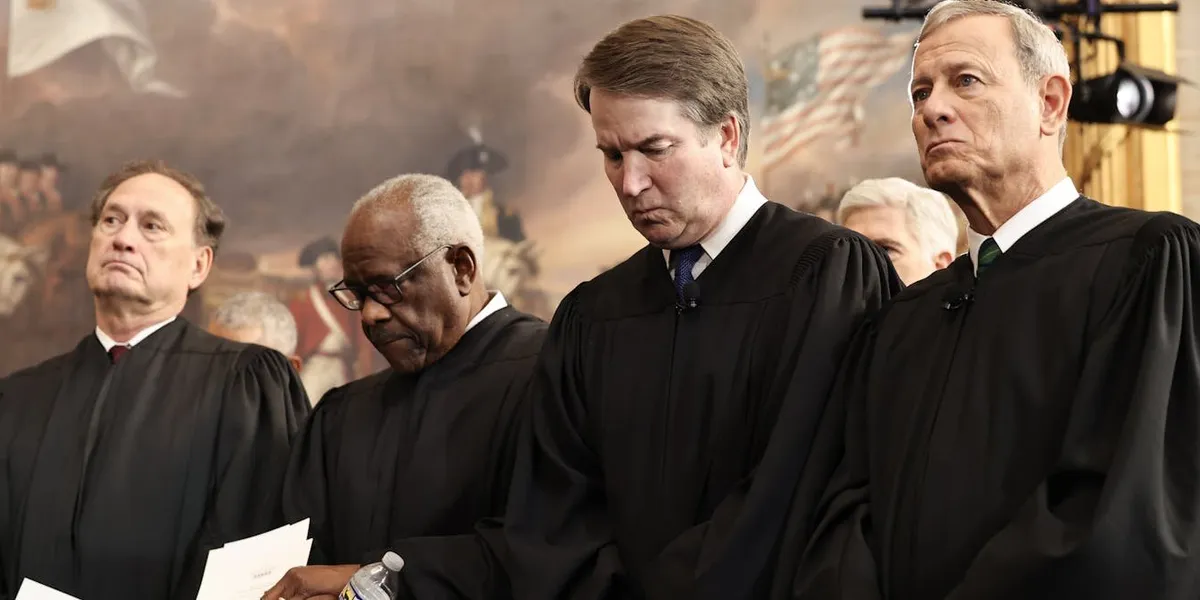
Elections are back before the U.S. Supreme Court: The to quickly lift an order blocking its efforts to put new restrictions on mail-in voting for the fast-approaching midterm elections.
Read more Trump creating the most ‘obvious target’ possible for his enemies
This article was originally published by Votebeat, a nonprofit news organization covering local election administration and voting access.
It’s unclear how the justices will rule, but the case focuses on a narrow question of whether or not the lower courts issued premature rulings rather than the broader questions about the legality of the executive order.
But no matter what the court decides this time, a series of practical and legal challenges make it increasingly unlikely that the federal government can impose new rules giving the U.S. Postal Service the power to block Americans from voting by mail in November’s elections.
Supreme Court Justice Ketanji Brown Jackson, the justice designated to handle emergency appeals from the 1st U.S. Circuit Court of Appeals, ordered the plaintiff states to respond by Monday to the Trump administration’s filing, and a decision could come any time after that. But there are already fewer than 100 days left until the election, and the U.S. Postal Service itself said in July court filings that it is running out of time to carry out the changes the president is demanding in time for this election.
The heart of the matter is President Donald Trump’s March 2026 executive order, which attempts to restrict mail-in voting by requiring creation of a series of lists of people eligible to vote, including one it requires the U.S. Postal Service to secure from states listing all voters eligible to use mail ballots. The order attempts to give the postal service unprecedented new power to prevent delivery of mail ballots to anyone who is not on these lists.
States, nonprofit groups, and Democratic party committees quickly sued over the order, which they argued was unconstitutional because the president has no authority over elections. Federal courts have since issued conflicting orders on the question of whether blocking major provisions would be premature because government agencies hadn’t yet taken final action to carry out Trump’s orders.
A judge in federal court in Washington, D.C. declined to block the challenged provisions, but last month, in a case brought by states, a federal judge in Massachusetts prevented the Trump administration from moving ahead with the plans, putting the whole issue on hold. Separate appeals courts have now upheld both rulings, leaving the Massachusetts injunction in place for now, which is what prompted the Trump administration to file its emergency appeal last week with the Supreme Court.
Still, “I think everyone agrees that it’s not going to be implemented for 2026,” said Derek Muller, an elections specialist at the University of Notre Dame Law School. “The logistics are so horrific.”
To be clear, the issue the court is now being asked to decide isn’t about the legal merits of the executive order itself, or whether Trump has the authority to issue it. The Trump administration is arguing that the federal courts blocked the executive order prematurely because the government is still drafting the rules, which haven’t been finalized. Until the rules are final, the Trump administration argues, the states can’t prove that there is any harm that should be blocked by the courts, or that agencies won’t carry out the order in a way that complies with the law.
Read more Trump’s stranglehold slips: Secret deal proves Republicans are revolting
The Massachusetts court’s injunction “is especially indefensible because the agencies are still deliberating over how (if at all) to implement the Order, yet the district court preemptively decided that whatever the agencies may choose to do will necessarily be unlawful,” the Trump administration argued in its 116-page filing.
That’s essentially what the other panel of judges from the U.S. Court of Appeals for the District of Columbia concluded in a ruling Tuesday when it upheld a lower court’s decision not to block the executive order — though the plaintiffs in that case are nonprofit groups and party committees rather than states.
“The scope of the issues at play” before the Supreme Court “are really, really narrow,” said Danielle Lang, vice president for voting rights and rule of law at the Campaign Legal Center, one of the lawyers involved in bringing the Washington, D.C. case.
And like Muller, Lang said it appears unlikely that the government would have the time to push through the changes before November.
“The kinds of dramatic changes they are asking for in election administration are not the kinds of things that you get done in a few months’ time,” Lang said. “As a practical reality, I don’t think they can do this in any non-chaotic way.”
If the Supreme Court were to side with the Trump administration this time, an army of lawyers across the country is prepared to again ask the courts to step in as soon as the new rules are finalized.
Even the appeals court judges in Washington that agreed the legal challenges were premature also suggested that they had some qualms about the executive order.
“Plaintiffs have identified a number of serious questions concerning the lawfulness of proposed actions if implemented on the threshold of the upcoming federal election,” the court said in its ruling.
Dion Nissenbaum is Votebeat’s senior national reporter and is based in Houston. Contact Dion at [email protected].
Read more Scorned Republicans wasting chance to ‘do more than just spit in Trump’s eye’