







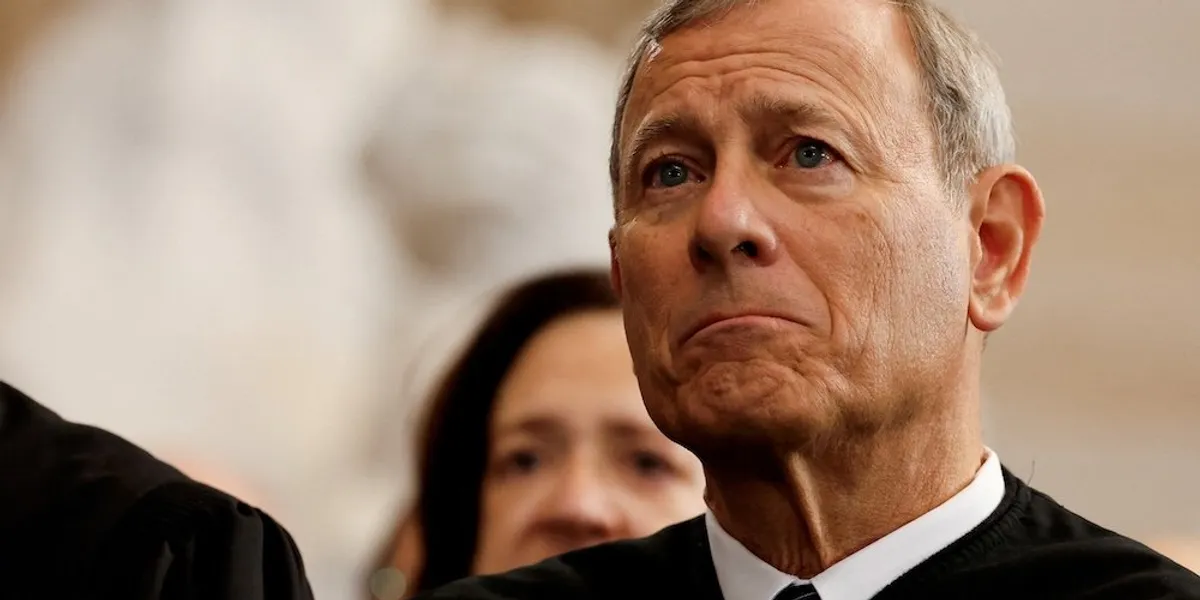
In recent months, the United States Supreme Court has handed down a string of consequential decisions that have prompted accusations that conservative justices have engaged in ideological overreach. Now on the Hawaiian Supreme Court, one justice is fighting back against what he calls “hubristic originalists.”
Read more Trump’s ‘Constitutional dumpster dive’ torn apart by comedian
According to Slate, in an opinion handed down on Wednesday, State Supreme Court Justice Todd Eddins “once again refused to import SCOTUS’s ‘results-driven approach to due process’ into state law. He explained that the Hawaiʻi Constitution ‘takes no instruction’ from ‘hubristic originalists’ who are ‘driven by agenda and intent on swiping power that belongs to the people.’ A Supreme Court ‘that systematically dismantles democratic safeguards, steamrolls constitutional liberties, and tramples human dignity,’ he concluded, ‘does not chart the course for the Hawaiʻi Constitution.’”
As Slate explains, “Sitting judges arguably have the best informed perspective on this Supreme Court: They must apply its jurisprudence, reconcile its contradictions, and confront the real-world effects of its rulings. It is a shame that so few are brave enough to speak candidly about the constitutional wreckage left by the Republican-appointed supermajority. The rarity of Eddins’ indictment makes it all the more valuable.”
The case decided on Wednesday concerns convictions built on false forensic evidence. According to Slate, “At Daniel Granillo’s 1990 trial for sexual assault, prosecutors used FBI hair-and-fiber analysis to place the victim in his car and bolster her account. He was sentenced to 40 years. Later, the National Academy of Sciences and a federal science panel such comparisons a unique source, and in 2017 the Department of Justice notified Hawaiʻi that the FBI expert in Granillo’s case had overstated what the method could prove.”
The court in Hawaii unanimously vacated his conviction, but was split on the governing rule. Slate explains that “ the false-evidence standard used when prosecutors knowingly present untrue testimony, holding that the state constitution makes the prosecutor’s knowledge irrelevant. ‘What matters is whether the trial was fair,’ he wrote, ‘not whether the prosecutor knew it wasn’t.’ A defendant need show only a ‘reasonable possibility’ that the bogus forensics swayed even one juror. Two harmless-error review, which would preserve the verdict if the state proved, ‘beyond a reasonable doubt,’ that the discredited testimony did not affect the outcome.”
Here Eddins recognized the influence of U.S. Supreme Court, and he accused the concurrence of trying to impose the federal court’s interpretation of due process onto the Hawaiʻi Constitution. He made this the basis for why SCOTUS’s conception should be rejected.
Read more Trump just gave a huge gift to Russia that will upend global power
“What this court has done to constitutional rights, democratic institutions, and the rule of law,” Eddins wrote, “explains why Hawaiʻi’s Constitution takes no instruction from it.” For example, the Hawaiian judiciary takes “no guidance on the meaning of due process from a court that gutted due process protections in Dobbs” by eliminating a “generations-long constitutional right, stripping autonomy from half the population, and empowering states to force birth.” It “does not import that results-driven approach to due process. We follow principles, not agendas.” And so it “does not anchor Hawaiʻi’s due process rights to the federal floor. Especially one that keeps sinking.”
But “the Supreme Court’s imperious ideology,” Eddins elaborated, “does not stop at due process. The same jurisprudence has cratered democracy itself.” Its “judicial demolition” of the Voting Rights Act culminated in Louisiana v. Callais, which “buried what remained of the crown jewel of the civil rights movement.” The supermajority “then ditched its own thirty-two day default for releasing decisions and hustled out its judgment mid-primary, a favor granted over objection only twice in twenty-five years.” Shortly after that, “on its shadow docket, the court tossed an eleven-day trial record built on fifty-one witnesses, 790 exhibits, 2,600 pages of testimony, and a 270-page opinion by a three-judge court.” In the process, “it resurrected a tainted congressional map the three-judge factfinders found deliberately entrenched racial bias against Black voters.”
The Roberts court, Eddins asserted, “sees only white. It refuses to acknowledge who the Equal Protection Clause was written to protect. The freed people, their descendants, and all others denied equal citizenship. It turns its back on what is in plain sight. The Fourteenth Amendment is not colorblind. It never was.”
“The court calls the Constitution colorblind while engineering the dilution of Black votes, the unraveling of hard-fought civil rights remedies, and the erasure of Black history,” Eddins declared. “That is not blindness. That is white sight, by design. A Constitution interpreted this way is not colorblind. It is whatever the court needs it to be. A way to advance its partisan project.”
Read more Secret Service is blocking a subpoena for Donald Trump Jr.