








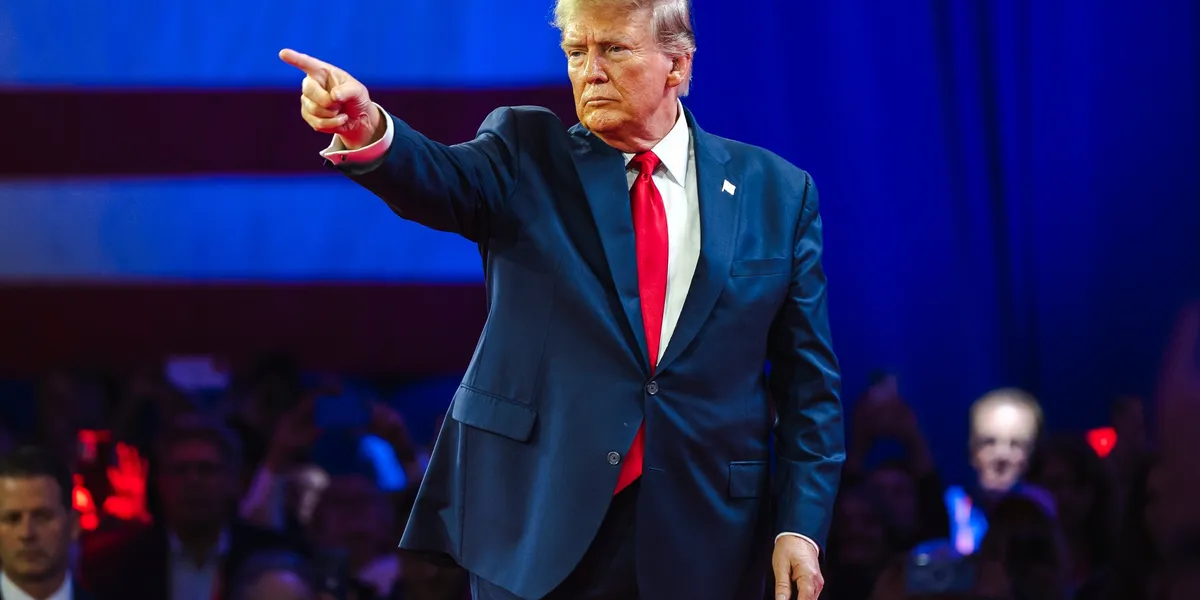
President Donald Trump has touted his Trump Accounts as a great investment vehicle to help young people build up savings, but one financial reporter argues that they are not living up to his promise.
Read more ‘Kook heaven’: Pro-Trump org descends into chaos as staff mysteriously resigns
“My 1-year-old son qualifies for a Trump Account, and I’ve opened it to claim the $1,000 government deposit,” reported The Wall Street Journal’s Adam Michel on Monday. “But I won’t be putting any of my personal after-tax wages in it, and neither should most parents. That is a shame. Trump Accounts are a good idea, poorly executed. A simple reform could make them worthwhile.”
Michel argued that Trump Accounts are flawed because they tax the money going into them and tax the money coming out of them.
“The accounts accept after-tax dollars from parents and other authorized individuals, but when the child turns 18, they convert to traditional IRAs for retirement,” Michel wrote. “That means the gains (along with the original $1,000) are taxed at withdrawal as ordinary income rather than at the lower capital-gains tax rate, which would have applied if the investment weren’t in a Trump Account. You pay taxes on the front end and the high rate on the back end. No deduction, no capital-gains rate, no flexibility.”
Describing a 529 as a better investment in terms of education savings than Trump Accounts, Michel concluded that Trump could easily fix this, and if he does not the Trump Accounts will amount to little more than a one-time gift to their recipients.
“The fix is easy: Lawmakers should pick a lane,” Michel said. “Make contributions tax-free and then tax the withdrawals. That is how a traditional IRA works. Alternatively, keep the after-tax contributions and make the withdrawals tax-free, like a Roth. Either path would give parents an incentive to add their own money. While they are at it, lawmakers should drop the lock-up rules and penalties, and instead let the savings roll into a more flexible account at age 18.”
Read more Trump’s DOJ is on a collision course with Texas landowners
Michel concluded that without those changes, “the $1,000 handout is where it stops. The rest I’ll save elsewhere.”
In May, a financial journalist for TheStreet pointed out a different problem with Trump Accounts.
“The federal government is less than two months away from opening Trump Accounts for private contributions on July 4, 2026, and a debate over what should go in them has begun,” TheStreet’s Damilola Esebame wrote at the time. “White House and Treasury officials have discussed allowing wealthy donors to contribute shares of stock directly into the children’s savings accounts, a shift that could reshape the program.”
Yet as Esebame observed, Trump Accounts upon being launched only accepted cash and invested it into low-cost S&P 500 index funds that cap the expense ratios at 0.1 percent. Even at the time, the White House and Department of Treasury began discussing altering the rules about how the accounts were managed so that stock shares could go directly into children’s savings accounts.
“If the rules change, millions of children already enrolled may end up with a completely different type of account,” Esebame said. “What you need to understand is how this fight over stock donations could affect the money designated for your child.”
Read more The latest smelly episode in Trump’s embarrassing Reflecting Pool saga