



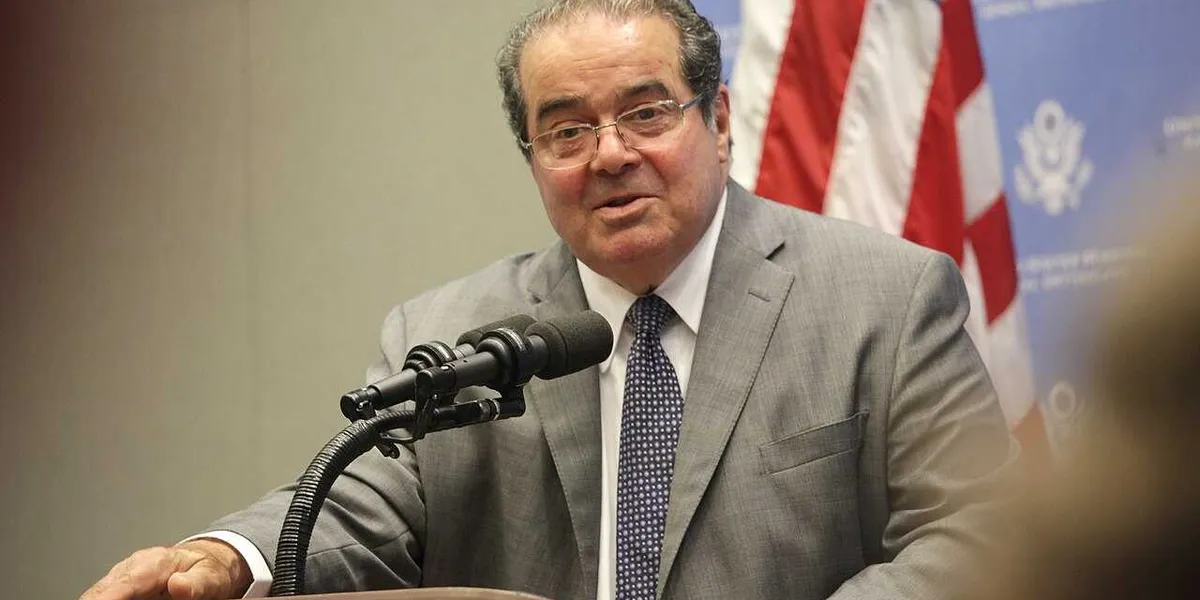
In Trump v. Slaughter — a case that went all the way to the U.S. Supreme Court — President Donald Trump is defending his right to fire Rebecca Slaughter, a former commissioner for the U.S. Federal Trade Commission (FTC). The case is pending, and according to Reason’s Damon Root, he may have the late Justice Antonin Scalia to thank if Trump v. Slaughter goes his way.
Read more Inside a conservative group’s ongoing battle with Trump
“Sometime in the next two or three weeks,” Root explains in the libertarian Reason, “the U.S. Supreme Court will decide a case about the president’s authority to fire independent federal agency heads ‘at will,’ rather than ‘for cause,’ as federal law currently requires. If President Donald Trump wins the case, as many legal observers think he probably will, a 1988 dissenting opinion by a famous conservative justice is likely to play a key supporting role.”
The 1988 dissent by Scalia was in the case Morrison v. Olson.
In that ruling 38 years ago, Chief Justice William Rehnquist and eight other justices examined a president’s ability to remove officers of the U.S. from office. Scalia was the lone dissenter, disagreeing with two fellow Ronald Reagan appointees — Justices Anthony Kennedy and Sandra Day O’Connor — as well as Rehnquist and Justices Thurgood Marshall, Byron White, Harry Blackmun, John Paul Stevens and William Brennan Jr.
“According to the Federal Trade Commission Act,” Root notes, “FTC commissioners may only ‘be removed by the President for inefficiency, neglect of duty, or malfeasance in office.’ Trump, however, purported to fire Slaughter for purely political reasons, which the statute, as written, does not allow. The question now before the Supreme Court is whether that statutory requirement amounts to an unlawful restriction on executive power. A majority of the Supreme Court seems inclined to view the law in that unforgiving light and rule in Trump’s favor.”
Read more Data analyst reveals 2028 presidential candidate is ‘way underwater’ in his home state
Root continues, “If the Court does so, among the legal authorities it is likely to cite is a solo dissent written by the late Justice Antonin Scalia in a case called Morrison v. Olson (1988)…. At issue in Morrison v. Olson was whether the existence of the independent counsel violated the constitutional separation of powers because it placed certain executive authorities beyond the immediate reach of the chief executive.”
Morrison v. Olson, like Trump v. Slaughter 38 years later, is grappling with how much executive power a president enjoys under the Constitution.
“Writing for the majority, Chief Justice William Rehnquist, a judicial conservative who was first appointed to SCOTUS by none other than (President Richard) Nixon, readily affirmed the independent counsel law…. Writing alone in dissent, Scalia offered a very different view of the matter,” according to Root. “The Constitution placed the executive power in the hands of the president alone, Scalia argued, and ‘this does not mean some of the executive power, but all of the executive power’…. If Trump does prevail in his efforts to fire Slaughter from the FTC, don’t be surprised when the long shadow cast by Scalia’s nearly 40-year-old dissent is visible in the Court’s decision.”
Read more Huge portion of Americans give grim prediction for country’s next 250 years